
The Fifth Sunday of Lent, 22 March 2026, Austwick, Clapham
Our two remarkable readings today are resurrection stories. They help us to anticipate our Easter celebrations, by prefiguring the resurrection of Jesus himself.
“Can these bones live?” is a question which never goes away. Can God breathe new life into a devastated people? Ezekiel’s people were the Israelites who had been deported to Babylon in the year 597BC. That year the Babylonians took Israel’s land, which had been God’s gift to them; they smashed Israel’s temple, the sign of God’s presence with them; and they exiled Israel’s king, Zedekiah, and executed his sons, ending the monarchy which traced its line all the way back to David, and trashing the promise that there would always be a king of his line on Israel’s throne.
‘The fall and destruction of Jerusalem was a catastrophe for Israel’, a sort of communal death, for they found themselves bereft of all which had defined them and sustained them; they were a people whose bones had dried up. Ezekiel envisioned the wilderness his people were in, and yearned, with them, for the dry bones to live again. [2]
I know that you can picture in your mind’s eye places in our world today similarly devastated and displaced by war, their people desperate for peace and security, yearning to rebuild their lives. As we stand witness to the valley of dry bones which is Gaza, as we lament the loss of over 180 children killed in the merciless bombing of their primary school in Minab, Iran, and we say, “Can these bones live?” it is an anguished prayer; it is a cry for help to a God we’re not sure is even there. For how can a loving God allow such suffering?
Martha said to Jesus, “Lord, if you had been here, my brother would not have died.” We know how she felt; if God had been present then surely we would have avoided this suffering. Where is God when we most need him? Where is God when it hurts?
†
The remarkable thing about the question “Can these bones live?” is that it’s not a question which Ezekiel asked God. It’s a question which God asked Ezekiel. Surveying the scene of dereliction and loss in the valley of dry bones, it is God who gives voice to the question which is in Ezekiel’s heart. “Can these bones live?”
This is the great revelation in this story: that God has not been absent after all – God has been there all along. God has seen the people’s loss, God has heard their cries and felt their pain, and God is longing to help them, just as they are longing to be helped.
All God needs is for Ezekiel to respond to this question, and he can then set in motion the events which will help, heal, restore, resurrect, the dry bones before them. Ezekiel seems a little lost for words at this point, maybe a little lost for faith, but eventually a brief and halting speech emerges from his mouth.
He said to me, ‘Mortal, can these bones live?’ I answered, ‘O Lord God, you know.’
And with that brief exchange God began to breathe new life into the bones before them. Ezekiel’s meagre and tentative expression of faith was sufficient for God to use him as the agent of this astonishing transformation.
God chose Ezekiel, an exile lamenting his people’s demise, a man who had just about enough faith to recognise that, if anyone could breathe new life into them and restore them, the Spirit of God was the one who could do it.
God choosing Ezekiel was like God choosing Martha and Mary to trigger the course of events which led to Jesus raising Lazarus from the dead. Grieving their brother’s sudden death you could imagine them being consumed by the question, “Can these bones live?” The sisters told Jesus, “Lord, if you had been here, our brother would not have died.”
And hearing their cries, feeling their pain, and responding tearfully to their loss, Jesus brought their brother back from the dead. At his command the Spirit moved. Breath re-entered his body. The bones of Lazarus took flesh, breathed, rose, and walked again.
These resurrection stories teach us the wondrous lesson that in situations of devastating loss and despair God is there – crying for us and with us; that indeed God is the first to give voice to our suffering and is ready, willing us to initiate our renewal. If we respond by placing our faith in him, our very trust releases his Spirit to revive, resurrect, and restore.
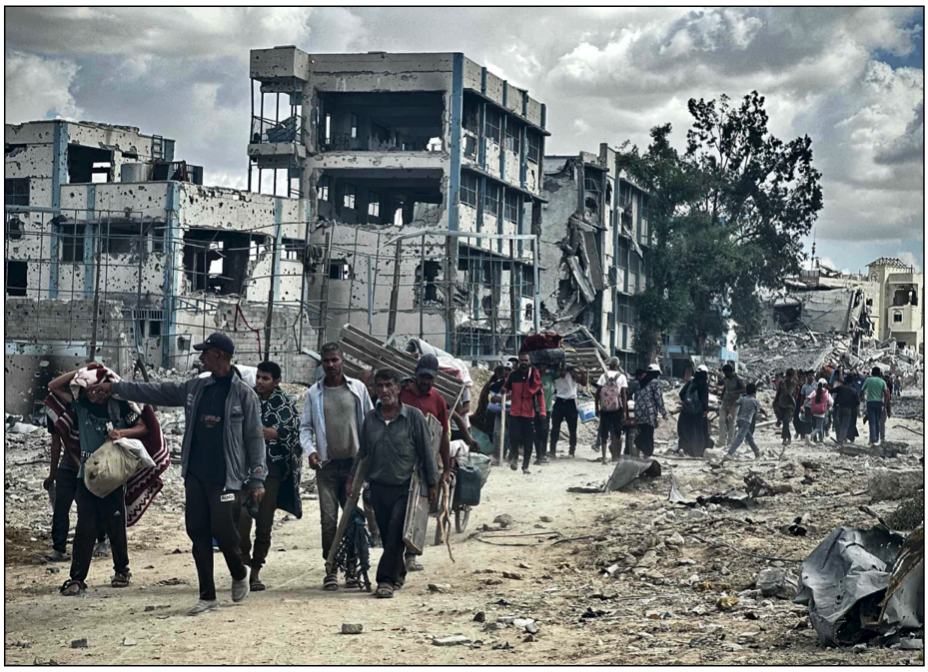
This photograph of Gaza portrays a street which looks like a valley of dry bones – a devastated terrain, in which we know, beneath the rubble, lie the lost but unforgotten dead. But it is also a picture of hope: for here are friends, families and neighbours walking together, carrying with them the possessions that they’ve recovered to help them begin to rebuild their lives. In that place, the Spirit is moving. Breath is re-entering these people’s bodies. Injured, yes, and troubled, yet they move forward together in hope.
To Martha and Mary, God healed the hurt in their hearts at the loss of their loved one, and secured a new beginning for them and Lazarus their kin. To anyone bereaved, whose heart is so hurting, just now, that they cannot see a future for themselves, what a hopeful message this is, that there is a life ahead for them to reach towards.
To Ezekiel, God offered an astonishing vision of the restoration of a whole society. To the faithless, broken, angry, hungry, homeless peoples of our day, what a powerful message this is: that unity and community is still possible for them, and will come, through the loving actions of those who come together to make it happen.
From Martha and Mary to all the bereaved; from the Israelites in exile to all of today’s uprooted peoples, this is God’s promise, pregnant with hope: ‘O my people. I will put my Spirit within you, and you shall live … then you shall know that I, the Lord, have spoken and will act, says the Lord.’
We close with a chant from the Taizé Community which echoes back to us the words Jesus spoke to Martha, “Did I not tell you that if you believed, you would see the glory of God?”
I am sure I shall see the goodness of the Lord
in the land of the living.
Yes, I shall see the goodness of our God,
hold firm, trust in the Lord. [3]
Notes
[1] Drawing from my earlier sermons Can these bones live? God’s pregnant promise preached in Austwick, Clapham, Keasden, 2023, Can these bones live? Devon, 2011, and Ezekiel: voice of the exile, Croxteth, 2008
[2] Charles R. Biggs, Book of Ezekiel; Epworth Commentary, xii.
[3] Taizé Community, ‘I am sure I shall see the goodness of the Lord’. From the collection Christe Lux Mundi ℗ Ateliers et Presses de Taizé, 2020.
[4] Gaza, 2025. Photograph: Anadolu/Getty Images