John’s Notes: Craven Faults

Clapham & District Newsletter, August-September 2026
Lately I’ve been listening to Craven Faults. By Craven Faults I don’t mean the major fractures in the earth’s crust across the Pennines. I mean Craven Faults, an enigmatic musician about whom, besides his music, little is known. “I’ve got friends who I’ve never told about this music,” he once told a journalist who he’d granted a rare interview to. Despite – or possibly because of – this elusiveness, Craven Faults’ music is well-received. He has released a series of EPs and three double-length LPs since 2017, in a form of instrumental music described by his record company (The Horsforth-based Leaf Label) as summoning ‘half-remembered journeys across post-industrial Yorkshire’. 2026’s Sidings LP – ‘loosely based on the journeys of freight traffic on the Settle-Carlisle line linking gypsum and limestone quarries to the national rail network over 150 years’ – peaked at number 15 in the UK album LP sales chart, and 4 in the downloads chart in February 2026.

The titles of his music tracks will resonate with residents of Craven and rural West Yorkshire. Some reference specific sites: Netherfield Works, Springhead Works, Lowfold Works; some natural landscape features as in the 2020 album Erratics & Unconformities; others man-made features such as Enclosures and Bounds. The epic May Birching (76 minutes long and accessible on YouTube and Bandcamp) ‘is named for the Northern tradition of secretly fixing greenery to people’s houses between sunset and dawn on May Day to indicate their character (e.g., sprigs of briar, holly and plum stood for liar, folly and glum)’.

Even if you’re not sure whether lengthy pieces of brooding electronic music are your thing, but you are interested in the human geographies and natural histories of ‘place’ – and this place, ‘our’ place, in particular – then I’d say that Craven Faults is worth investigating.

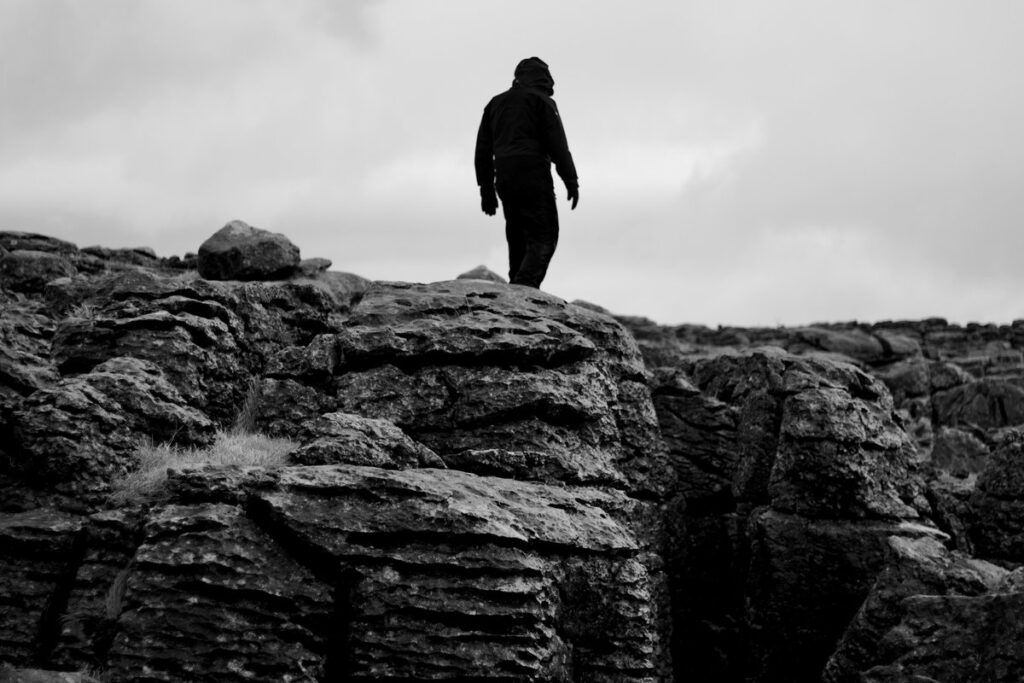
It’s not just the music, with Craven Faults. Each record sleeve is impeccably designed, featuring monochrome landscape scenes on their covers, images of abandoned mines, drystone walls, former mills and tumbledown barns. ‘I am looking for shapes in the landscape,’ he says. Removing the colour ‘helps. It removes the obvious beauty of a spectacular view and leaves something slightly different. I try to avoid making them dramatic. I’m trying to make the subjects look as natural as possible.’

In an essay on Craven Faults in Northern Earth (Issue 184, Summer 2006) Phil Hubbard expands on this: ‘There are no scenes of tourists thronging chocolate-box perfect villages here, nor any Grand Designs conversions suggestive of the type of rural gentrification that has beset rural Yorkshire since the Covid-19 lockdown encouraged working from home. This is a search for the layers beneath, repressed histories of place and identity which are there just below the surface if one looks – and listens.’

Craven Faults’ musical meditations derive from his keen observed eye for detail in these upland Northern landscapes, its old broken gate posts, its clapper bridges over becks, its abandoned cow houses. One inspiration is Arthur Raistrick, whose 1972 book Industrial Archaeology started Craven Faults ‘off on this journey’ when he purchased it from a junk shop. As Hubbard reports, ‘Raistrick was a Yorkshire polymath best known as a pioneer in English Landscape Studies, producing over 300 books, pamphlets and articles, mainly on the landscapes of the North Of England. But unlike W.G. Hoskins, who argued little of any beauty was created after the 18th century, Raistrick argued the beauty of the Yorkshire Dales – dry stone walls, vernacular buildings and packhorse ways – was entirely the product of the industrial era.’

Thought to have been a member of a successful group who toured America and Europe in the late 1980s, the journey which led him to become Craven Faults began with a leisurely ramble around the tiny village of Hebden, halfway between Grassington and Appletreewick. ‘I could see a chimney in the distance,’ he recalls. ‘The remains of Yarnbury lead mine. All the spoil heaps are grassed over now, but the ground is still rough. There used to be 5,000 people living in that valley, but now they’ve all gone. It was a town, and now it’s not. And I found that really interesting – the way urban places can become rural places.’

To appreciate the layers and details of landscape as sculpted by human activity over many centuries requires the same sort of deep listening which Craven Faults’ lengthy meditative music invites. For him, the key seems to be about making art which helps the artist and their audience to take a long view of time. He told Phil Hubbard, ”Idols and Altars’ (a track on his Standers LP) makes me think of pre-Christian religion or something like that. It’s to do with carved rocks and things on Ilkley Moor. And the track itself is quite slow and it’s got a melody which is spacious, like you hear music in church. I don’t go to church. Never have. But sometimes when you hear like a church organ, there’s something about the physical space of the sound. That is, there’s a slowness to it.’

Craven Faults: cravenfaults.com; YouTube Channel; Bandcamp artists page.

Northern Earth: northernearth.co.uk

See also Bob Fischer, Craven Faults: Faulty Towers in Electronic Sound, July 13, 2023
Embracing the unconformity – minding the gaps

Book Reviews

Horatio Morpurgo, A Guide to the Unconformity

Phil Smith, Mind the Gaps, Mind the Fields

All published in the Fault Lines essay series by Triarchy Press, 2026

When a schoolboy discovered a 16th Century astrolabe in Lyme Bay in 1967, no-one paid any attention. The retrieval of this rare maritime navigational instrument provoked no interest locally and barely any in academia. In A Guide to the Unconformity, #1 in Triarchy Press’ Fault Lines essay series, Horatio Morpurgo asks why. 

On one level, A Guide to the Unconformity is a local history deep-dive, in which Morpurgo investigates his subject from every discoverable angle. On another level, this is a manifesto for a deeper kind of engagement with the local, an encouragement to wait long enough for a place ‘to answer the questions it raises for you’. It’s a beautifully crafted little book full of engaging details, which draws the reader ever deeper into The Undercliff, whilst speculating on The Unconformity.  

The Undercliff is a wooded area of coast between Seaton and Lyme Regis, prone to landslips and difficult to traverse, where John Fowles wrote The French Lieutenant’s Woman, whilst The Unconformity is a geological feature of the area, a fault-line sandwiched between datable rock strata which represents ‘80 million missing years’, a ‘colossal break in the sequence’. 

Morpurgo proposes that the term unconformity be ‘upcycled for wider use, with the clays and earthiness of its original context still sticking to it’. In a world which causes us increasingly to think and act algorithmically, Morpurgo wants us to embrace the unconformity, which ‘may take the form of something very close to home, some emblem or story which matters very little to anyone else’, which can’t be explained very well, but is ‘the place we all have to go sometimes, even though it isn’t very brightly lit, away from the praise or blame of others.’

The Unconformity is a gap – in rock structure and in time – and gaps are the concern of Phil Smith. In Mind the Gaps, (Fault Lines essay #2), Phil describes our world as one whose grand narratives are increasingly failing, and proposes that we attend instead to the gaps in ‘the disturbed edges of culture, ecology and everyday life’ to imagine a different way of thinking and being. This essay, and its partner Mind the Fields, invite their readers to ‘attend to absences, to find places of change in bubbling vacuums and to experiment with living differently in the leaks and loopholes of existence’.

Smith’s ‘unconformity’ is The Empty Temple: a place whose emptiness is an opportunity: to say “I am nothing”, whilst sitting in the emptiness, and the quietness, and waiting, or leaving it empty ‘to see what happens close by’. 

I’m privileged to have the care of four country churches, which are left always open and which enjoy daily visitors of every kind (in a week or two the swallows will be rebuilding their annual ecclesial nests). By far the most fruitful, energising encounters of each day are those unexpected, unpredictable, ones with those visitors; and there’s a thrill of uncertainty in the gap which exists between the initial greeting between us, and what will follow… which can be anything between “Do you have a toilet?” to an hour investigating different forms of moss on ancient headstones. These are my moments of (quoting Smith’s concluding words) ‘finding wisdom in the random; intuiting what chance is speaking … in coincidences across fields of space’.

Mind The Gaps / Fields gave me much food for thought. 

As regards gaps, being increasingly dissatisfied with grand narratives (and feeling frustratedly duty-bound ‘in role’ to have to show assent to their inconsistencies, e.g., to have to recite The Creed week by week), I’m more than ready to apply myself to seeking out gaps to see what they reveal. If anything – or if nothing. Problem for me is, a functional instinct: an attachment to the need to always have to ‘find something’ in everything. In my case Nietzsche wasn’t wrong when he wrote,  “On Priests”, that “into every gap they put their delusion, their stopgap, which they called God”. My cairn terrier Poppy noses into every gap in every dry-stone wall seemingly convinced she’ll find a rabbit therein. It’s only very occasionally that she does, but whatever the outcome she seems at peace with the gap-nosing process: that’s the kind of peace I’m after learning to seek. A peace disinterested in achieving ‘understanding’, a satisfaction with purely ‘being’.

In Mind the Fields I especially liked Phil’s passages on folklore, having thoroughly previously enjoyed Crab & Bee’s Matter of Britain, Smith’s collaboration with Helen Billinghurst, ‘An inspired re-telling of some of the finest tales and tropes of England, at once very old and very modern’ (Ronald Hutton).

Smith discusses ‘the partial, intuited knowing’ possible in ancient stone circles and burial sites and the ‘enigmatic’ yet ‘recognisable’ and ‘accessible’ qualities of folklore as increasingly explored today in a turn – from what he helpfully terms the 1960s ‘transactional reaction within commerce’ – which like him I also hope will be more significant and lasting through being more self-critical than the counter-culture which precedes it. 

Whereas Horatio Morpurgo’s essay demonstrates the effect of remaining rooted to a spot for long enough (a long time) for it to begin to reveal itself to you, I find Phil Smith’s two essays are characteristically playful: like so much of his writing, these evoke a sense of invitation into forms of play – with words, concepts, intuitions, play which is both enjoyable and invigorating inasmuch as it opens up new ways of experiencing. 

I’m grateful to Triarchy Press for launching the Fault Lines essay series, to ‘explore the cracks in the stories modern civilisation tells itself – about progress, control, care, truth, and what counts as ‘real’.’ Each of these short books succeed in the publisher’s aim to ‘open a seam where systems grind against lived experience, where official narratives no longer fit what people feel in their bones.’ 

About Horatio Morpurgo / Phil Smith

The Shoot from the Stump – the weird energy of hope

Clapham Village Newsletter, December 2025

If you go to a service of Lessons and Carols, you’re likely to hear that weird seasonal scriptural phrase, “A shoot shall come out from the stump of Jesse, and a branch shall grow out of his roots.”  It comes from the old prophet Isaiah, who had eyes to see what no-one else could: in a place of desolation, signs of new beginnings.

In the Eighth Century BC the Assyrians got busy expanding their empire with extreme ruthlessness. Where once they had used international extortion to spread their kingdom, the new mode of Assyrian conquest was to destroy the very infrastructure of the societies and cultures they invaded. Which is what they did to Israel in 722BC. And in Judah, the weak king Ahaz became a vassal of their dreaded powerful pagan enemy.

Assyrian imperial propaganda proclaimed the supremacy of their god Ashur and declared that the conquered peoples had been abandoned by their gods. And so it seemed to the tribes of Israel, the sons and daughters of King David, the son of Jesse, who were absolutely broken. Their kings had failed them. Their cities were laid waste; like an axed-down tree stump they were cut low.

But along comes Isaiah with a remarkable vision – the vision of a shoot coming out from the stump of Jesse, the promise of a branch growing out of his roots. The promise of one who would create an alternative community of peace in a wounded world. Isaiah described one who, contrary to their occupying rulers, would “judge the poor with righteousness” and “decide with equity for the meek of the earth”; he saw “that one day all would live on God’s holy mountain without fear of hurt and destruction”. 

“The wolf shall live with the lamb,” Isaiah writes, “the leopard shall lie down with the kid, the calf and the lion and the fatling together, and a little child shall lead them” – weird but wonderful images of a world where conflict has given way to concord.

This Advent season gives us permission to open our eyes to a different view of life, to recognise the green shoots of rebirth today. When we do, we find them everywhere. The squaddie who lost a limb in Afghanistan now competing in regional sports; the recovering addict now sponsoring someone starting out on  the twelve steps; the community which lost its pub and its post office now running their own; the overworked businessman who, following a stroke, gave up his career to become a full-time foster carer; the estranged family members reconciling; the villagers rebuilding together after the floodwaters have subsided; Southport’s community gardeners winning this year’s Britain in Bloom. 

The shoot from the stump, the branch growing from the roots: do we find these images relatable because they are drawn from nature? Ancient Judah’s ordinary people lived close to the land; Jesse was a farmer. Assyrian settlers had sequestrated their land, imposed rents and taxes upon them; Jesse’s son David turned his back on the family’s agrarian life to occupy himself with kingship and empire-building. But within the people’s deep understanding of the natural way of things, lay their intuition that no amount of oppression or devastation could stop the green shoots of goodness seeking a way to re-emerge: slowly, almost imperceptibly, but indefatigably.

Could it be that the Animals and Insects are the AI best suited to guiding us into a better future? I think that our popular services of Lessons and Carols appeal because they are rare occasions allowing us to embrace the deeper realities within this alternative view of life; and to be empowered by them into taking part in its nurture. 

“Optimists think it will all be fine without our involvement; pessimists take the opposite position; both excuse themselves from acting,” writes Rebecca Solnit in Hope in the Dark. But, “Hope is an embrace of the unknown and knowable, an alternative to the certainty of both optimists and pessimists. Hope locates itself in the premises that we don’t know what will happen and that in the spaciousness of uncertainty is room to act.”

This is our season of believing that the force which brings life out of the dormant earth, which drives the good shoots to break through from the stump, is alive and active in the world; it is the energy through which we can live, and act, in hope. 

Note

Based on my 2016 sermon, The Shoot from the Stump in the Advent of Trump.

Things you can do with a sign of the cross

Clapham Village Newsletter, October-November 2025

He went to the crossroad, fell down on his knees – did old Robert Johnson. He asked the Lord above, “Have mercy, save me if you please”.

There’s a lot of things you can do with a sign of the cross. You can make it a meeting place with the devil or with the Lord, like the blues singers do. You can make it a request for divine assistance in the manner of footballers, arriving on the pitch eyes lifted in petition, genuflecting. You can have it smeared in ash on your forehead to signal the start of your Lenten abstinence, or baked in to a hot cross bun when you break that fast. You can put it on a road sign. You can use it to direct people towards medical assistance or to signify a country on a flag. You can buy cross-shaped necklaces in all kinds of designs: I’ve heard jewellers say that occasionally a shopper may request “one with a little man on it”. 

In vicar training school they told us that following our ordination – the cathedral service when the bishop says special prayers for us – we would be uniquely empowered by The Church to bestow blessings on people by the simple cross-shaped motion of our hands. Now, I grew up with an understanding of “the priesthood of all believers” so I venture to suggest that anyone, with the genuine intention of blessing another, could do it in this way, to the same effect, should they so wish. 

Which isn’t to deny how much I cherish those moments at the end of our services where I’m able to send people out with a blessing, or when I make the cross-sign as a greeting at someone’s doorway, or on a baptised child’s forehead, or at a hospital bedside, with a family bidding their fond, prayerful, farewells to their loved one about to depart this life.

A sign of a cross can be a sign of welcome – as when it flies above St James’ Church tower, the Cross of St George signalling a church which is open for all. It’s a sign of the Church of England, that is, a church here to serve everyone on this island, of whatever circumstance in life. For some onlookers this red-cross-on-white may signify this country which they love, whether for its cricket or its creatures, its shipping forecast or its peculiar weather, but mostly because, for them, regardless of its shortcomings (which are legion) it is familiar and it is home. 

Of course, you can also use the cross as a sign of hostility, as we see it displayed on the gowns of the Klu Klux Klan whilst going about their lynchings, or when painted onto roundabouts in antagonism against a maligned minority group. I suggest that this cruel inhumanity is the most faithful use of a sign of a cross, because it is the closest in meaning to the cross’s original intention. For in Christianity the original cross was the mechanism for Jesus’ execution. In gospel times, crosses were how manipulative political players and aggravated crowds got rid of those they’d demonised. 

Three people hung at Calvary that day. Jesus and two condemned companions: were they each a scapegoat of sorts, the fatal violence inflicted on them a convenient way of galvanising the community? In this telling, the sign of the cross is a bloody, horrible, human, thing: this urge to “exterminate all the brutes”, it is “the sin of the world”. 

Why then would the Christian church turn the cross into a golden icon of temporal glory shining within some of the world’s most showy, expensive buildings? Some say because of Roman Emperor Constantine’s vision of a cross in the sky, on the night before a big battle, which he won, and his consequent adoption of the motto, “In this sign you shall conquer”. Thus the cross became an emblem of empire, a triumphalist symbol, a justification of state violence; with the notion of self-sacrifice at the heart of Christ’s offering on Calvary now commandeered for military purposes.

Another reason why the cross became glorified is that the Church came to see it as a sign of the success of the resurrection. Those necklaces with the little man on them only tell the start of the story. The empty crosses tell it all: “He is not here – he is risen!” Thus the cross becomes the sign of the possibility of redemption – and particularly for those who the world wants to crucify. 

We see this in bombed-out cities where at the sight of the Red Cross, the injured find cause for hope; we see it on stormy seas where at the sight of the RNLI flag – with the cross at its heart – those who thought themselves lost to the waves know that rescue is at hand.

You can use the sign of the cross for any purpose. Who will use it as a sign of hope? Who will use it as a sign of healing? Who will use it as a sign of grace and of redemption?

The Flag of St George is a sign of welcome

Austwick Parish Newsletter, September 2025

When Revd Al Barratt, vicar of Hodge Hill, Birmingham, heard that a protest was planned outside a local hotel accommodating asylum seekers, he said, “My first, bodily, response was to feel sick. My second response that closely followed, in my guts but also in my head, was that we, the local church, needed to do something.”

In his Substack, ‘Loving our Neighbours when the Flags have Gone Up’, Revd Al describes, with refreshing honesty, his congregation’s modest attempt to respond with care and solidarity for to the hotel staff and residents; to offer their church as a place of welcome and sanctuary; and to engage positively with the protesters (“some local people… under whose anger lay just the kind of struggles and fragilities that we knew all too well from our community-building work… People feeling deeply unsettled by a world changing around them, and with little agency or power to do anything about it.”) Wearing hi-viz jackets with ‘Peace Chaplain’ on their back, the church volunteers walked among them offering them cupcakes and flowers, and flyers saying, “You are all our neighbours (Both outside and inside this hotel.) We are from the local Christian community (Church of England). We love you. God loves you. We believe in, and are working for, a local community where all are welcome, all are valued, all are listened to, and all have what they need for a decent life.”

Revd Al’s article is a fascinating read (https://substack.com/home/post/p-172087759): and it illustrates a truth that The Bishop of Oxford, The Rt Revd Stephen Croft describes in his ‘Open Letter to Nigel Farage’, published at the end of August: “The British people, as I understand them, want public policies founded on the deeply British and Christian values of compassion and care for those in need….”

I’d recommend Bishop Stephen’s full letter. It is a thoughtful and clearly stated affirmation of positive Christian values brought to bear on the complex issue of immigration (https://blogs.oxford.anglican.org/an-open-letter-to-nigel-farage).

I’d also recommend Horatio Clare’s ‘We Came By Sea: Stories of a Greater Britain‘ (Little Toller, 2025), “an untold story of the small boats crisis, a story which shows the best of us. It is the story of the volunteers who help thousands of refugees in Calais, of the lifeboat crews mounting one of the great search and rescue operations of all time, of an unrecognised, uncelebrated, all but unknown Britain which is giving its all to help the vulnerable and desperate. It is a journey through an unexamined nation, a nation which is as truly great and good as the people in the dinghies believe Britain to be. It is not the story we have been told, and it is a true story.”

Through reading Clare’s book I’ve realised that new arrivals in the country regard the flags of St George and the Union Flag as signs of welcome, friendship, new beginnings. Those nearing the end of their precarious journey across the Channel, increasingly fearful of their boat capsizing, delight to see that flag on the Dover rescue boat because they know that means they’ll make it safely to land. Beneath that flag they are welcomed with a generous sausage fry-up by volunteers at the reception centre; to those seeking safety that flag represents a country which, they believe, will receive them with kindness. Which, on the whole, it does. For when push comes to shove the refugees believe, and we know, that the majority of people will show “the deeply British and Christian values of compassion and care for those in need” which Stephen Croft described in his letter.

The flag of St George flown from our churches is a sign of welcome. At its heart is a cross, which is the sign of sacrificial self-giving for the sake of others, a sign of love and care especially for those most in need.

“I’ll be your treasure” – What I’ve learned from Detectorists

Clapham and District Village Newsletter, August 2025 [PDF]

Mackensie Crook and Toby Jones in Detectorists

Mackenzie Crook and Toby Jones in Detectorists


“Will you search through the loamy earth for me?

Climb through the briar and bramble;

I'll be your treasure…

I'm waiting for you.”

This is how TV’s Detectorists theme tune begins. It’s a lovely song by Johnny Flynn which you can listen to here. I discovered Detectorists recently, and late: it was first screened in 2014; and I soon became a fan. It’s a gentle, sublimely scripted sitcom with a great cast, based around the Danebury Metal Detecting Club (DMDC), a small collective of enthusiasts who spend all their spare time in fields of Essex stubble, and meet every Tuesday in the scout hall opposite the Two Brewers on the High Street to discuss each others’ finds (mostly ring-pulls and buttons). 

The series’ writer and actor Mackenzie Crook said that “I wanted Detectorists to be uncynical… a slower-paced, understated show that wasn’t out to test any boundaries or be controversial, a comedy that didn’t need a gag every eight seconds but had space to breathe.”

The programme’s subject matter, he says, is “people and their hobbies, the strange obsessions with which people fill their spare time.” Underlying it all (pun very much intended), Detectorists is about finding treasure. 

Andy (played by Crook) and Lance (Toby Jones of ‘Mr Bates and the Post Office’) are obsessed with the idea that a royal Saxon ship-burial is located on a nearby farm, and that drives the storyline through the programme’s three series. But whilst this subterranean treasure eludes them, the characters find greater value in their relationships, which fluctuate just as our own relationships do, between hope and loss, love and betrayal, acidic lemonade and convivial ale. Viewers see them develop in unexpectedly profound ways. Detectorists sweeps the surface of ordinary everyday life and unearths precious hoards in the hidden depths.

Andy knows that his greatest treasure is Becky, his ambitious schoolteacher partner whose trust he twice has to recover, after having his head momentarily turned by an attractive student DMDC newcomer, and then struggling to support Becky in her desire to volunteer abroad. Self-absorbed divorcee Lance finds something in life to cherish when his long-estranged daughter Kate comes along to turn his loner lifestyle upside-down.

Lance (Toby Jones) in Detectorists

Episode by episode, above the tree where Lance and Andy sit eating their lunch, the magpies go about their own treasure hunt; whilst beneath their feet, as Johnny Flynn’s song plays, the camera pans deep down into the English earth to rest, eventually, on the elusive, glistening, Danebury hoard.

I recently posted this message on a Detectorists fan page: “I'm a vicar and a couple have asked me if they can open their wedding service with Johnny Flynn's Detectorists theme song. I think it's perfect for the occasion. I've told them I'll be emotional.” I was overwhelmed by the unreservedly positive response this received from well over 500 people, including one who commented, “My daughter had it for her wedding, it was indeed a very emotional way to start proceedings, I didn't really recover!”, and another who wrote, “We gave our lovely dad a natural burial and followed his wicker coffin out to his burial to that song. It was just so perfect. Our dad loved wildlife and bees and is now surrounded by them always. Us 3 girls made his coffin topper from all the wildflowers he had planted in his garden … a perfect send off for him that felt so spiritual.”

We’re all seeking treasure of some sort. It’s wonderful when you find it, especially in everyday life. It’s even better when it’s a treasure you discover, and share, together with others. 

Detectorists is on BBC iPlayer.

Beer and Hymns, rejoicing in a venerable tradition

“The coming of summer ushered in not merely a season in which the flowering of nature led minds naturally to rejoicing, but one in which the clemency of the air made the implementation of that desire most practicable,” writes historian Ronald Hutton in The Stations of the Sun. “It was therefore in that period that the people of pre-industrial England gave themselves up to communal merry-making with particular frequency, a tendency reinforced by the fact that it lay conveniently between the heavy work of ploughing and sowing, and that of hay-making.” The Church played its part in these festive gatherings, often known as ‘ales’, by authorising a Whitsun holiday, and in time inaugurating occasions known as ‘Church Ales’. These were not so much ‘Church in the Pub’, but rather ‘Pub in the Church’, or more accurately, ‘Pub just outside the Church’, for (as Hutton writes) “there were always scruples about putting a sacred building to secular use, especially that which might conduce to inebriation and irreverence.” But hosting an ‘ale’ in the church grounds – and using it as an occasion for parish fundraising – was a way of avoiding episcopal censure, and even courting the bishops’ approval.

Beer and Hymns advert

So when the good folk of St Matthew’s Church, Keasden decided to host a Beer and Hymns evening on 22 June this year, we found ourselves falling into a longstanding British tradition of ‘Church Ales’, the sacred and the secular coming together in festivity. A contemporary inspiration for this, for me, is the Beer & Hymns events held throughout each August Bank Holiday weekend at Greenbelt, a music and arts festival with Christian roots and a broad reach held in the English countryside (its current home is Boughton, an estate of 11,000 acres in Northamptonshire, and a seat of Richard Montagu Douglas Scott, 10th Duke of Buccleuch and 12th Duke of Queensberry). Beer & Hymns started life at the Greenbelt Festival in 2006. Led by Tim ‘the stout but not fat Landlord’ Fox, with Dave ‘Monkey Boy’ Ball on the piano, and ‘Adorable’ Hannah assisting on the mic, festival goers were invited to raise their pints and sing some hymns. “The rest is history,” they write, at www.beerandhymns.org, and continue:

“Dave and Tim used to take groups of young homeless people, families, staff and volunteers from their local YMCA for weekend retreats. One evening over a beer, after running out of Beatles songs, they started singing classic hymns and discovered that people of all ages, creeds, colours and beliefs enjoyed immensely the singing of the great old Wesley tunes and the majestic words that went with them. Some years later, Tim was asked if he would consider running the Organic Beer Tent at Greenbelt, and determined the drinking of beer and singing of hymns would be a great addition to the life of the pub, which was renamed as The Jesus Arms. On the first evening, with just a small piano, no hymn sheets and the first few bars of And Can It Be they were joined by over five hundred people: singing their hearts out and raising glasses in the hostelry. On that day Beer & Hymns was truly born.”

Our June evening will no doubt be a more modest occasion, but we’ll gather, pint in one hand and hymn sheet in the other, in the spirit of the olde-English parish festival-goers and those who today make their annual pilgrimage to The Jesus Arms, to share a sup, a song, and a few good smiles.

Ronald Hutton writes that “In the mid-thirteenth century, bishops orders repeatedly forbade the attendance at ‘ales’ of clergy (who might compromise their dignity at such events).” Beer and Hymns, Keasden Church, 7.00pm on Sunday 22nd June – I’m prepared to take a chance.

John’s Notes: Can Jeff Bezos save me?

Clapham and District Village Newsletter, October 2024

Can Jeff Bezos save me? The Amazon oligarch is investing millions in anti-ageing research which aims to “make 90 the new 50 by 2030”. His delivery service brings the world to my door in no time: which is wonderful, except when his courier leaves the package on my step in the rain, forcing me to go through the whole vexing ‘returns’ process again.

Maybe Elon Musk can save me? The Tesla billionaire is developing a self-driving car which will get me to Morrisons without my having to steer, accelerate, brake, or navigate. His Twitter once kept me in good conversations with friends, colleagues, and interesting influences: but now X embroils me in a chilling world of paranoid conspiracies about the NHS being part of a genocidal ‘hygiene dictatorship’.

Or perhaps Richard Branson can save me? The Virgin magnate is funding spaceships which in future will let me escape this exhausted earth and take a trip to the Moon, or to live on Mars. I loved his early work, especially ‘Tubular Bells’: but my Virgin Broadband box keeps recording unrequested TV programmes from BBC Wales.

It resonates with me that Jesus never presented himself as a messiah. When his closest disciple Peter called him that name, Jesus said, ‘Get behind me, Satan!’ and described himself instead as a ‘son of man’, a ‘suffering one’. Meaning that his affinity is far less with the tech oligarchs, and far more with the ones who feel – and are made – powerless in the face of all this invasive technology.

To me, this makes the ‘son of man’ one with the 17-year-old first-time driver whose insurance company threatened him with debt collectors when his car’s black box reported him as driving his 18-year-old VW Polo at 540mph. It makes him one with the treasurer of the little rural church pressured to pay ridiculously inflated electricity bills because the smart meter readings bear no relation to reality. 

He’s one with those exhausted by the ceaseless task of displaying their public face on social media to keep up appearances; and he’s one with those who worry about what the corporations are doing with all the data about them extracted by their mobile devices, their Alexa or Siri, their TV set and digital doorbell; he’s one with those troubled about which emails are genuine and which ones are ‘phishing’ to flush out our bank account.

Digital technology now dominates education, the social security system, seeking job opportunities and signing up for cheaper gas and electricity. ‘Digital poverty’, not being able to afford to interact with the online world, is many people’s everyday experience. Through groups like Church Action on Poverty and the APLE Collective, people at grassroots are seeking to redress this balance.  

We all benefit from the good side of digital tech, but it can cause people to feel alone in this world, it can separate us from others, it does make people vulnerable to the whims of the powerful forces of the corporations which rule our lives. Which is why it is good to see how many people, from the margins, are working hard to rebuild community, to unite with others to resist all which frightens or diminishes us.

GOD IS SICK OF US NOT LEAVING THE MUNDANE

John’s Notes: Clapham & District Newsletter, Oct-Nov 2023

A plaque on the wall inside the Church of Saint John the Evangelist on New Briggate, Leeds, reads: SIC DEUS DILEXIT MUNDUM. Dick Bonham translates this as GOD IS SICK OF US NOT LEAVING THE MUNDANE. Dick was a theatrical producer of ‘ghost nights’ inside St John’s when he guided me around the ‘redundant’ church some years ago, and he was being playful. I was amused to discover that the Latin dictionary translation is GOD SO LOVED THE WORLD, which struck me as meaning almost the opposite.

I’ve been revisiting that day, in preparation for a talk I’m giving to Clapham’s Age UK group on 4th October. It was 19th September 2007, during a two-month-long deliberately slow walk I made from Hull to Liverpool, loosely following the motorway which connects them, which I called ‘Walking the M62’, and is the topic of my talk. 

My Leeds city tour was hosted by Dick and others from his theatre company, whose particular schtick was to create activities and events encouraging the general public to take a fresh and creative look at the world immediately around them, whether in Leeds city streets, or the hamlets of England along The Great North Road, or Cornish coastal towns.*

We connected on my M62 walk because our intentions were similar: to discover and celebrate the awe and wonder latent beneath the surface of everyday life. I was then living in a housing estate parish, one of those places which suffer from the lazy assumption that all these ‘little boxes’ thrown up in the 1930s, ‘all made out of ticky-tacky’, ‘all look just the same’ and must be therefore the location of very humdrum lives. A mere scratch beneath the surface gave the lie to that, of course, and this was confirmed in a series of ‘Parish Walks’ I did with locals and visitors, where conversation and observation brought the place to life in rich and unexpected ways.

You don’t have to Latinise or spiritualise this observation: that the minutiae of everyday life has significance and value, wherever we are; and intentionally exploring the life under our very noses is so unexpectedly enriching, we miss out if we don’t do it.


* See these blog posts for more on this: God is sick of us not leaving the mundane, September 19, 2007; To the edges and back, November 20, 2006.

If there’s time for the loud, there’s time for the quiet. If there’s time for the fast, there’s a need for the slow

Churches Weekly Newsletter – No.163, 4 June 2023

I think our having grandchildren around this half-term week, and my upcoming birthday, have combined to get me brooding over my age…. and being encouraged by what the next generation are achieving. One whom I’ve been thinking of is Sarah Corbett, who I used to chat with around the kitchen table of her home in the vicarage of St Peter’s, West Everton, when she was a schoolgirl and I was a community worker alongside her mum Jane. Sarah’s dad Henry recently retired after over forty years of ministry in one of Liverpool's lowest income communities, and Jane went on to become West Everton's city councillor and a Deputy Mayor. Sarah has said,  "All we ever do around the kitchen table is talk about religion and politics."

At the age of three Sarah joined her local community squatting in social housing to save them from demolition (they won), and with her parents she later visited South Africa to learn about the Peace and Reconciliation work of Nelson Mandela and Desmond Tutu. She became a professional campaigner for NGOs including Christian Aid and Oxfam GB, and the UK Government Department for International Development (DFID). But something wasn’t quite right. In 2008, Sarah, a self-described introvert, "burned out from too much confrontation, and, doubting the effectiveness of many elements of conventional activism, starting looking for alternatives." She discovered craftivism – a term coined by American writer and crafter Betsy Greer in 2003 – and decided to have a go at creating her own craftivism projects.

Craftivism is a combination of 'craft' and 'activism'. There are limitless possibilities to what craftivists do, including hand-sewing positive messages to post to MPs, crafting colourful mini-banners for public display, helping kids create bunting expressing their  desires to improve the world, and leaving crafted Valentine’s cards for people to find, containing messages inviting them to ‘brighten up someone’s day’.

Sarah Corbett: Craftivist Collective

Sarah says, “If there’s time for the loud, there’s also time for the quiet. If there’s time for the fast, there’s also a need for the slow. In everyone’s heart is a desire to change things for the better – it is essential that there is an activists toolkit that is as diverse as humanity.” Sarah’s unique ‘Gentle Protest’ approach to craftivism gained a following of friends and strangers around the world who wanted to get involved. And so, in 2009, the Craftivist Collective was born.

Today the award-winning Craftivist Collective has thousands of members, who Sarah supports by developing tools and projects that they can undertake as individuals or by organising their own small group 'stitch-ins'. Sarah has also delivered events, talks, workshops and events to over 12,000 people around the world. Her first book, A Little Book of Craftivism, came out in 2013, and she has since published a more in-depth guide, How to be a Craftivist: the art of gentle protest. In July 2022 Sarah was presented with an Honorary Fellowship from Goldsmiths, University of London for her "contribution to design activism and public engagement.”

This week Sarah sent news of her plans to publish The Craftivist Collective Handbook, which “is going to be a beautiful, hardback book of 20 craftivism projects and tools to help you on your journey as a positive and effective change-maker. Each project explains ‘How To’ create these ethical craftivism projects, and just as importantly ‘Why To’, so that you can fulfil the potential of your campaign with both a strong strategy and mindful process.” Being a full-time craftivist is hardly lucrative, thus Sarah’s request for supporters to finance this project. If you’re interested to read more about craftivism, or to donate towards Sarah’s work, please click over to the Craftivist Collective website.