
John’s Notes: Craven Faults

Clapham & District Newsletter, August-September 2026
Lately I’ve been listening to Craven Faults. By Craven Faults I don’t mean the major fractures in the earth’s crust across the Pennines. I mean Craven Faults, an enigmatic musician about whom, besides his music, little is known. “I’ve got friends who I’ve never told about this music,” he once told a journalist who he’d granted a rare interview to. Despite – or possibly because of – this elusiveness, Craven Faults’ music is well-received. He has released a series of EPs and three double-length LPs since 2017, in a form of instrumental music described by his record company (The Horsforth-based Leaf Label) as summoning ‘half-remembered journeys across post-industrial Yorkshire’. 2026’s Sidings LP – ‘loosely based on the journeys of freight traffic on the Settle-Carlisle line linking gypsum and limestone quarries to the national rail network over 150 years’ – peaked at number 15 in the UK album LP sales chart, and 4 in the downloads chart in February 2026.

The titles of his music tracks will resonate with residents of Craven and rural West Yorkshire. Some reference specific sites: Netherfield Works, Springhead Works, Lowfold Works; some natural landscape features as in the 2020 album Erratics & Unconformities; others man-made features such as Enclosures and Bounds. The epic May Birching (76 minutes long and accessible on YouTube and Bandcamp) ‘is named for the Northern tradition of secretly fixing greenery to people’s houses between sunset and dawn on May Day to indicate their character (e.g., sprigs of briar, holly and plum stood for liar, folly and glum)’.

Even if you’re not sure whether lengthy pieces of brooding electronic music are your thing, but you are interested in the human geographies and natural histories of ‘place’ – and this place, ‘our’ place, in particular – then I’d say that Craven Faults is worth investigating.

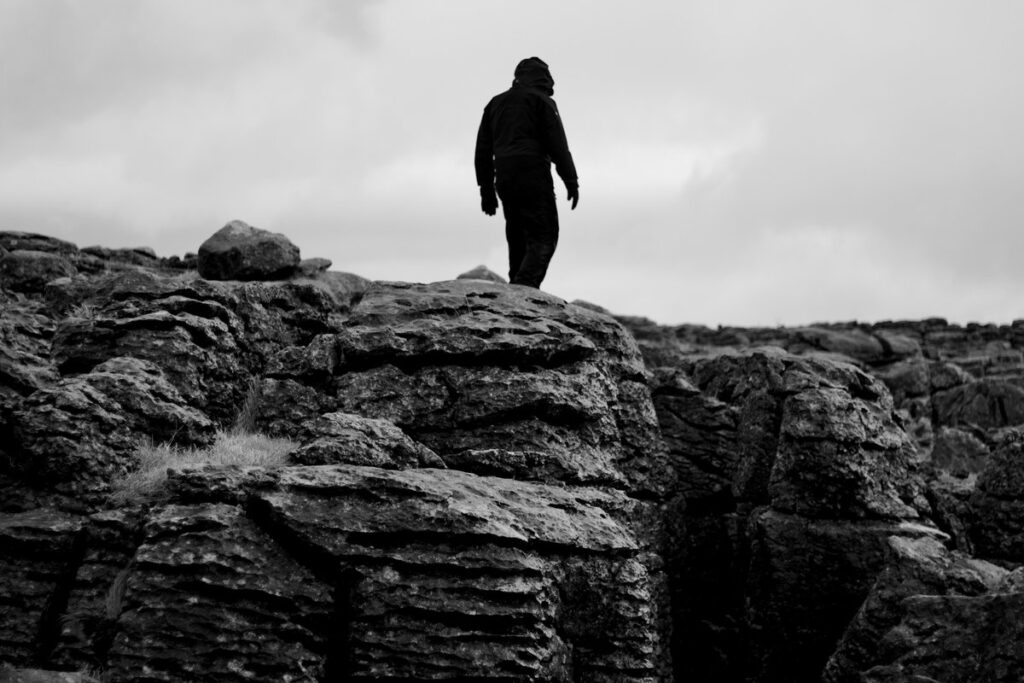
It’s not just the music, with Craven Faults. Each record sleeve is impeccably designed, featuring monochrome landscape scenes on their covers, images of abandoned mines, drystone walls, former mills and tumbledown barns. ‘I am looking for shapes in the landscape,’ he says. Removing the colour ‘helps. It removes the obvious beauty of a spectacular view and leaves something slightly different. I try to avoid making them dramatic. I’m trying to make the subjects look as natural as possible.’

In an essay on Craven Faults in Northern Earth (Issue 184, Summer 2006) Phil Hubbard expands on this: ‘There are no scenes of tourists thronging chocolate-box perfect villages here, nor any Grand Designs conversions suggestive of the type of rural gentrification that has beset rural Yorkshire since the Covid-19 lockdown encouraged working from home. This is a search for the layers beneath, repressed histories of place and identity which are there just below the surface if one looks – and listens.’

Craven Faults’ musical meditations derive from his keen observed eye for detail in these upland Northern landscapes, its old broken gate posts, its clapper bridges over becks, its abandoned cow houses. One inspiration is Arthur Raistrick, whose 1972 book Industrial Archaeology started Craven Faults ‘off on this journey’ when he purchased it from a junk shop. As Hubbard reports, ‘Raistrick was a Yorkshire polymath best known as a pioneer in English Landscape Studies, producing over 300 books, pamphlets and articles, mainly on the landscapes of the North Of England. But unlike W.G. Hoskins, who argued little of any beauty was created after the 18th century, Raistrick argued the beauty of the Yorkshire Dales – dry stone walls, vernacular buildings and packhorse ways – was entirely the product of the industrial era.’

Thought to have been a member of a successful group who toured America and Europe in the late 1980s, the journey which led him to become Craven Faults began with a leisurely ramble around the tiny village of Hebden, halfway between Grassington and Appletreewick. ‘I could see a chimney in the distance,’ he recalls. ‘The remains of Yarnbury lead mine. All the spoil heaps are grassed over now, but the ground is still rough. There used to be 5,000 people living in that valley, but now they’ve all gone. It was a town, and now it’s not. And I found that really interesting – the way urban places can become rural places.’

To appreciate the layers and details of landscape as sculpted by human activity over many centuries requires the same sort of deep listening which Craven Faults’ lengthy meditative music invites. For him, the key seems to be about making art which helps the artist and their audience to take a long view of time. He told Phil Hubbard, ”Idols and Altars’ (a track on his Standers LP) makes me think of pre-Christian religion or something like that. It’s to do with carved rocks and things on Ilkley Moor. And the track itself is quite slow and it’s got a melody which is spacious, like you hear music in church. I don’t go to church. Never have. But sometimes when you hear like a church organ, there’s something about the physical space of the sound. That is, there’s a slowness to it.’

Craven Faults: cravenfaults.com; YouTube Channel; Bandcamp artists page.

Northern Earth: northernearth.co.uk

See also Bob Fischer, Craven Faults: Faulty Towers in Electronic Sound, July 13, 2023

A Celebration of God’s World in Summer: 1

Introduction: Creation groaning

The Seventh Sunday after Trinity, 19 July 2026

Austwick, Clapham, Eldroth

“We know that the whole creation has been groaning in labour pains until now,” writes St Paul. 

Creation groaning – when we hear that phrase, we might think of our poor world, its plants and its creatures and their struggles to survive the excesses of human behaviour which – we must now surely humbly accept – are proving increasingly damaging to the rest of the natural world.

Creation groaning – under the heat of our increasingly warming planet. Creation groaning: as the seas rise and as species are lost to pollution, over-hunting and over-fishing we can almost hear the sound of nature crying in its despair and decline.

I won’t go on, we know the situation and it saddens us. 

But St Paul didn’t stop at creation groaning. He said that “the whole creation has been groaning in labour pains until now.”

Now, this, his full statement, takes us somewhere quite different altogether. It takes us from lamenting what is being lost in creation, into a place of hope.  For the groaning of labour pains is a groaning which leads to new life. The groaning of labour pains anticipate new birth, new worlds being born. Paul is giving we, his readers, hope that despite the extreme painfulness the beloved earth is currently experiencing, a new world will come. 

“The creation itself will be set free from its bondage to decay and will obtain the freedom of the glory of the children of God,” Paul writes. This new beginning for creation is shared with humankind, suffering, broken, humankind. As he puts it:  “and not only the creation, but we ourselves, who have the first fruits of the Spirit, groan inwardly while we wait for adoption, the redemption of our bodies.”

The much-loved naturalist David Attenborough has said about humans that “We moved from being a part of nature to being apart from nature.” 

“The truth is,” he said, “the natural world is changing. And we are totally dependent on that world. It provides our food, water and air. It is the most precious thing we have and we need to defend it.”

Saving the planet, taught Attenborough, means saving ourselves. “Laid upon us, whether we like it or not, is an awesome responsibility,” he said. In our hands now lies not only our own future, but that of all other living creatures with whom we share the earth.” [1]

Maybe the best place to start to take that responsibility to heart is to affirm and celebrate our love for God’s world in all its beautiful complexity. And if we want to celebrate our love for God’s world then a very good place for us to start is in song. 

There are many beautiful songs which celebrate creation, from traditional hymns like All Creatures of Our God and King – a joyous prayer of St. Francis of Assisi rewritten in Victorian times – to How Great Thou Art, popularised during Billy Graham’s crusades of the last half of the twentieth century.

But perhaps the most popular, most enduring, also the simplest, purest, celebration of God’s world, is All Things Bright and Beautiful, an Anglican hymn, also sung in many other Christian denominations, written by Cecil Frances Alexander and first published in her Hymns for Little Children of 1848. [2]

‘Fanny’ Alexander, as she was known, may have been inspired by Psalm 104, verses 24 and 25: “Oh Lord, how manifold are thy works! in wisdom hast thou made them all: the earth is full of thy riches. So is this great and wide sea, wherein are things creeping innumerable, both small and great beasts”. 

She may also have been inspired as well by a verse from Samuel Taylor Coleridge’s The Rime of the Ancient Mariner, which goes: “He prayeth best, who loveth best; All things great and small; For the dear God who loveth us; He made and loveth all.”

Or maybe inspiration may have come from William Paley’s Natural Theology, published in 1802, that argues for God as the designer of the natural world. The hymn speaks of “tiny wings” and “eyes to see them”, and Paley cited wings and eyes as examples of a complex design, like a watch, with God as the Divine Watchmaker.

Fanny Alexander was the daughter of a a land-agent on an Irish estate, and began writing poems and songs as a child. By the time she married the Anglican clergyman William Alexander, afterwards Bishop of Derry and Archbishop of Armagh, in 1850, she was a successfully published, and well-travelled, writer. [3]

Inspiration for Alexander’s hymn text “The purple-headed mountain, The river running by” has been attributed to four separate locations in Wales, Ireland and England. Alexander visited Llanwenarth House in Govilon, Monmouthshire in 1848, and it is claimed that the hymn refers to the nearby Sugar Loaf Mountain or the Blorenge mountains, and to the River Usk. Other places where Alexander is known to have visited have also been suggested as inspirations: the gardens of Markree Castle near Sligo, the village of Dunster in Somerset, and the landscape of Grabbist Hill and the River Avill.

It may have been that “the purple headed mountain” is in Benevenagh, County Londonderry, a place she often visited, and “the river running by” is the River Roe which flows there. We will never know for sure, but what we do know is that whenever we sing this song – first learned at school – the words invoke in us pictures of the places and things in nature which mean the most to us. 

For the next few Sundays this summer I’m going to invite you to reflect with me on different lines from All Things Bright and Beautiful, so that we can celebrate God’s world together. Next week I’ll talk about “Each little flower that opens”; in subsequent weeks we’ll think about “Each little bird that sings”, “The ripe fruits in the garden”, “The tall trees in the greenwood”, and finally “The sunset and the morning”. I hope you’ll find these little reflections helpfully refreshing reminders of all the beauty the surrounds us, and inspiration to keep on caring for it all as best we can. [4]

God saw all that he had made: And it was very good.

On the sixth day God completed all his work,

Heaven and earth with all their mighty throng,

And God blessed the seventh day and made it holy

Because on the seventh day he rested from all his work.

Notes

[1] David Attenborough quotes from goodreads.com.

[2] Wikipedia:  All Things Bright and Beautiful.

[3] Wikipedia: Cecil Frances Alexander.

[4] These talks are based on ‘A Celebration of God’s World in Summer’ in The Staffordshire Seven, Seasonal Worship from the Countryside,  pp.105-114.

Let my heart be good soil today

Romans 8.1-11, Matthew 13.1-9,18-23

The Sixth Sunday after Trinity, 12 July 2026, Austwick, Keasden

How would you describe what a parable is? I’d say that Jesus’ parables were “earthly stories with a heavenly twist”.  He drew his stories from real life, but often gave them a twist in the tale, to awaken his audience to some fresh perspective from God which he wants us to discover.

So let’s look at this morning’s Parable of the Sower. It seems straightforward, but there are at least two twists in this tale that would have struck Jesus’ audience. The first is that this sower apparently does nothing to prepare his field before sowing the seed. He doesn’t clear any rocks out; he pulls no weeds; he doesn’t turn the soil over. No, this free-spirited sower simply goes out into a field with a lot of rocks and weeds and trampled down, hard ground, and flings the seed anywhere and everywhere.

The second aspect of this story that would have given Jesus’ audience a jolt is the ending: the good soil that produces thirty, sixty, and a hundred-fold. This is an unheard-of harvest!Today, with our heavy, mechanised agriculture we would expect that sort of outcome. But in Jesus’ day, thirty, sixty, and a hundred-fold would be an outrageous expectation for a harvest. 

So what is going on? What heavenly perspective is Jesus presenting to us here? Let’s compare the Parable of the Sower with another well-known story, The Parable of the Prodigal Son, which also has a heavenly twist.

What’s really surprising in the story of the Prodigal Son is not so much that a young son would make mistakes, prodigally wasting his father’s money. No, that’s quite common, isn’t it? What’s surprising is how easily the father welcomes him home afterwards. From the standpoint of the elder son, who had remained faithful to his father, his father was the prodigal one, wasting such love on a good-for-nothing son. 

Now, that invites us to see today’s parable as being the story of a Prodigal Sower, a farmer who seemingly wastes most of his seed on soil that isn’t going to produce much, if anything. This sower throws out lots and lots of seed, and he doesn’t seem to care where he throws it.

But Jesus isn¹t trying to teach us about farming, but about God’s kingdom, and that¹s why there’s this heavenly twist in the tale. The Prodigal Sower is meant to surprise us into seeing that God’s kingdom is wonderfully different than what we might expect it to be. It first helps us unlearn something about God’s kingdom before we learn something new and wonderful. 

We might believe that the most precious commodity in God’s kingdom is God’s loving forgiveness. And if we do, then Jesus is teaching us that there is an unlimited supply of it, enough for everyone. God can afford to ‘sow’ it absolutely everywhere, because there is never any danger of God running out of it. 

So we need to unlearn the idea that there might be a limited supply of God’s love and mercy, that there will come a day when God’s mercy will run out, and God’s wrath will do all the evil-doers in. We need to unlearn this stuff about God’s wrath, which sounds less like a loving Father God and rather more like us and our limited amounts of mercy. We need to learn that the supply of God’s mercy does not give out, he just keeps on sowing and sowing that seed until it will one day yield a fantastic harvest. 

There is something else very important to unlearn – that is, our habit of always trying to decide who’s in and who’s out. This parable seems to divide up people into groups of who’s in and who’s out. There are three kinds of soil, representing three kinds of people, who resist and reject God’s word as bearing fruit in them. They all reject the word. We are tempted to assume we know who the bad ones are, and to assume that we are the good soil – but is that the message, really? 

Let’s look again at the climax of the Gospel story: Jesus hanging by himself on the cross, utterly and totally rejected. The cross is the ultimate in heavenly twists. Not even his disciples have joined him in this terrible fate, those closest to him who might have thought they were the good soil in his parable. They have all run away afraid at the first sign of persecution – in other words, even they have turned out to be like rocky soil, those who fall away when persecution arises. 

Jesus is God’s Word made flesh given to this world. And when all was said and done, no one had eyes or ears or minds to understand. That Word was completely rejected. But on Easter morning it bore fruit anyway. God raised that seed of Jesus’ death to bear the fruit of new life precisely in the teeth of such total rejection. 

God has to be so prodigal with that word of loving forgiveness, that seed God planted in this world through Jesus Christ, because all of our hearts are so stubborn to truly receive it. If God wasn’t so prodigal in sowing the seed, it never would have stood a chance, because this whole world had become tramped down and rocky and overgrown with weeds. There was no good soil left. 

If you or I were given a field that was completely grown over and rocky, what would we do? Abandon it perhaps. Or get a big, powerful plough of some sort and at least try to plough it all under, in order to find some good soil. But notice that is not what God did in Jesus Christ. God did not plough us all under and start over. That happened in the story of Noah and the flood, with its rainbow which tells us that God tried that way once and promised never to do it again. 

No, instead God kept on sowing the seed of his loving forgiveness anyway, and it bore fruit not just in spite of the rejection of the bad soil but through it. It was precisely by Jesus himself becoming the Rejected One on the cross that God somehow bore the fruit of new life. This is where the parable leads us, and the mystery of God’s grace comes forth. God sowed his mercy in the cross and the incredible harvest was the resurrection. 

There is one further twist to this parable. If I am to unlearn the usual human story filled with divisions and strife, then I need to unlearn looking at myself as good soil and others as bad soil. 

No, I must remember that I am the whole field and have all those sorts of soil in me. In my life there is sometimes hard soil and rocky soil and weeds which rejects or fails God, and sometimes there is good soil that bears the fruit of sharing God’s limitless love with others. 

God never stops sowing his grace into my life. I must constantly pray, then, that by his grace, my heart and life may be good soil today, good soil which will bear good fruit. 

Thank God for being such a generous sower; Lord, let my heart be good soil today. 

 John Davies

Note

This sermon is substantially based on a sermon of Paul Nuechterlein, The Prodigal Sower, Girardian Lectionary, Reflections,  Year A, Proper 10A Sermon (2002); and this version is a rewrite of Matthew 13 – The Prodigal Sower preached in Somerset in 2014 and Norris Green in 2005.