Not far from each one of us

Acts 17.22–31, John 14.15–21

31 May 2026, Waterloo United Free Church

‘Paul stood up in front of the city council…’ the Good News Bible tells us. This might cause you to picture a mahogany-panelled Town Hall chamber full of worn leather seats, but this was ancient Athens and quite a different place altogether. Other versions of the Bible give the city council its name: ‘Paul stood in front of the Areopagus…’ they say.

The Areopagus. It sounds like the sort of name that we might give to a glitzy shopping precinct, or a multiplex cinema. In ancient Athens it was a place of great seriousness: the seat of civic power. For, named after Ares, the Greek god of war, the Areopagus was the principal council of Athens, imposingly sited just beneath the Acropolis overlooking the city on a rocky outcrop called the ‘Hill of Ares’. Less like a Victorian council chamber and more like a stirring ancient sports stadium. 

The Areopagus was where influential people exercised their power, where powerful people reinforced their influence, and their judgments and policy decisions were directed by their devotion to their many different gods. 

Although the people considered their gods immortal, and far more knowledgeable and powerful than humans, they also regarded them as being persons rather than abstract concepts. Spiritual and active in the physical realm. These deities were described as being similar to humans in appearance, albeit larger and more beautiful. Their emotions and actions were largely the same as those of humans; they were sexual and warlike, jealous and amoral. [2]

The gods were spiritual entities who took on real physical shape and form in the world. 

Their divine power allowed the Greek gods to intervene in mortal affairs in various ways: they could cause natural events such as rain, wind, or epidemics, they could make crops grow or withhold them, and they could dictate the outcomes of complex human events, such as battles or political situations. No wonder they were worshipped at altars all around Athens, and invoked at the meetings of the city council.

Among these gods, besides the violent warrior god Ares, there was Aphrodite, the goddess of love and beauty; Demeter, goddess of the harvest who gave feast or famine according to her mood; Apollo, the god of healing; and Zeus, father of all people, leader of the gods. 

Paul had noticed that there was a god in Athens for every eventuality in life, and the streets were full of altars to all of them. But he noticed something striking about one of these altars. It didn’t have a name on it: no Zeus, no Athena, no Medusa. Just a simple plaque which read, ‘To an unknown god.’ It fascinated Paul that with so many gods around to help shape their lives, the people had a sense that there was still another god who they didn’t yet know and couldn’t yet see, flourishing in a realm perhaps outside that of all the other divinities. A different sort of god altogether.

I want to suggest to you this morning that we, in our society today, are very like the ancient Athenians. We fill our villages, towns and cities with altars to all sorts of gods. These are “the rulers, the authorities, the powers of this present darkness”, as St Paul once described the spiritual forces which dominate our world in tangible ways: the spiritual entities who take on real physical shape and form in our world. [3] 

God-like forces rule our lives. It’s just that we don’t often think about them in this way. We might not regard them as ‘gods’, but when we consider the function that these Powers have in our world, we might see the similarities with how the ancient Greek gods functioned for their people. 

The ancient Greeks would have said, and so might we: that we look to these gods to provide for us in every area of life; we pay our tributes to them to satisfy them; to show our devotion to them we display their icons everywhere on our clothes, accessories, in our homes and on our city streets; we shape our very lives around the demands they make on us. So please bear with me as I suggest to you that…

  • today we have the god Asda, a giant who straddles the earth providing all the food and drink we could ever need and whose priests are dressed in bright lime-coloured robes;
  • today we have the god Bupa, who promises to attend to all our health needs at speed, though also at great cost; 
  • today we have the god Lotto, who promises us the earth but disburses his gifts very sparingly; 
  • and today we have the god Google, who offers us the knowledge of everything we ever want to know, whilst disclosing details of our every move to other ‘gods’ for profit.

Please bear with me as I ask you to consider that these prominent corporations are among the great Powers which dominate our lives. You may not find it helpful my calling them ‘god-like’, but I do this to try to encourage the understanding that these Powers are both earthly bodies and spiritual beings. The theologian Walter Wink devoted decades to studying and discussing what the Bible means by the ‘principalities and powers’, and what that means today. He wrote that

The Powers are not spiritual spooks inhabiting the air and leaping on the unwary. That was an earlier way of putting it. Nor are they merely institutions, political or economic systems, ideologies, or social structures. That has been the modern way of coming at it. Neither is adequate, though both contain some truth. 

The Powers consist, it turns out, of an outer manifestation and an inner spirituality. Every material or tangible manifestation of power has its inner or spiritual aspect, whether it be the spirit of a sports team, the morale of a business office, the ‘corporate culture’ of a transnational corporation, or the ethos of a nation. [4]

Paul said that the gods revered in Athens were “like gold, or silver, or stone, an image formed by the art and imagination of mortals.” But that makes them no less spiritual. Bupa and Lotto, Nike and Asda are beings ‘formed by the art and imagination of mortals’, and they each have their particular spirit, their particular way of being in the world. We can sense this if we think of the different natures of, let’s say, Everton and Tranmere Rovers, or of the different cultures of Waitrose and Aldi, the different spirits at work in HSBC and our local credit union.

Whatever their tangible and spiritual differences, however, each of these bodies are part of God’s creation; indeed, part of Jesus’ creation – for in Colossians Paul teaches that “In him all things were created: things in heaven and on earth, visible and invisible, whether thrones or powers or rulers or authorities; all things have been created through him and for him.” [5]

The Powers have been created for good: each of them having a purpose which glorifies God and benefits creation. So, just like Apollo, Bupa was created for the purpose of healing. Just like Athena, our universities were created for learning and wisdom. But, just as we individuals can fall away from God’s good purposes for us, so too can these great Powers fall away from their divine vocation – their purpose to serve the common good. “When an institution prioritises its own interests over this purpose, its spirituality becomes pathological or ‘demonic’”, writes Walter Wink. When corporations prioritise their own profit over health and education, for instance, then they are fallen, in need of redemption. [6]  

The ancient Greeks saw this in their gods. They were ambivalent about Ares, for instance, after whom the Areopagus was named. Although Ares embodied the physical valour necessary for success in war, the Greeks saw that he also personified sheer brutality and bloodlust; he had a savage, dangerous, militarised quality which troubled the people. [7]

Likewise today we feel ambivalence about so many of the Powers at large in our world. For we know that despite all the blessings these so-called gods may bestow on us, they’re incapable of satisfying our deepest-down, aching, needs: their behaviours lead to conflict and distress. We’re conscious that despite living in one of the wealthiest, most comfortable societies the world has ever known, the pursuit of the gods of wealth and comfort brings with it poverty and discomfort. The Powers-at-large so often fail us.

We can be both appreciative of the many positives about the internet, and deeply concerned about its darker side. We’re disturbed by the dissonance between our love of nature and our dependency on resource-devouring technology which is increasingly overheating the planet and decimating those very species which we love. We’re troubled that the creeds of consumer happiness driven by the Powers of this world create a cruel competitive culture of high anxiety, anger, fear and loathing, self-loathing and depression. 

I think that this disquiet, felt by so many people worldwide, tells us that there is an altar in our public space named for an unknown god: one who the people of our day and time hope might satisfy where the other Powers lack; a god not in competition with the other gods – who are all in competition with each other – but one who, rather, transcends them. 

In the council of the people of Athens, Paul put a name to their unknown god. A number of names, in fact. He called him the God and Father of our Lord Jesus Christ; he said he is the God who made the world and everything in it; the Lord of heaven and earth who gives life and breath to all people and all things, in whom we live and move and have our being.

Paul told the Athenians that the unknown God is very different; that the God and Father of our Lord Jesus Christ isn’t a warrior god who will conquer all by the force of arms, but a servant God known through his ultimate act of self-giving love on the cross. This unknown God is not a Power concerned with titillating or pampering us or making us affluent, but is the Father of all people everywhere, who calls us to turn around, to turn our faces towards this One who he has appointed to judge the world in righteousness, this man who he has raised from the dead. 

It is very good news, to many, to discover the Powers of this world are not, in fact, the ultimate gods, but are actually simply part of God’s creation. They are in our lives, and they are created to serve us; sometimes they do this well, and at other times they fail us. But our ultimate call is to walk with Jesus, to follow in his way to live in a state of love with God, the earth, and all people. 

So that we do not become entrapped by the spirit of these Powers, Jesus promises us the Spirit of truth, to be with us for ever, to give us the help we need to turn our lives around to live in His way, day by day. [8]

At the Areopagus Paul told the Greeks that in every generation people “would search for God… though they might perhaps grope their way towards him to find him… for indeed he is not far from each one of us.” [8] So let us pray – Jesus, give us the Holy Spirit to help us – and to help others –  in that search. 

Notes 

[1] An extended version of Groping our way towards the unknown god (2026), Austwick, 10 May 2026, and its previous iterations, Groping our way towards the unknown god, preached online, 2020, and Gods of yesterday and today, preached in Liverpool, 2005.

[2] Wikipedia: List of Greek deities.

[3] Ephesians 6.10-20.

[4] Walter Wink, The Powers Behind the Throne. Sojourners, September 1984.

[5] Colossians 1.12.

[6] Walter Wink The Powers That Be : Theology for a New Millennium.

[7] Wikipedia: Ares.

[8] John 14.17.

[9] Acts 17.27 in David Bentley Hart, The New Testament: A Translation. Other quotations are from the New Revised Standard Version, Anglicised.

The Holy Spirit Unites the Kingdom

Acts 2.1-21, John 20.19-23

Pentecost, 24 May 2026, Austwick, Clapham

The Holy Spirit Unites the Kingdom. 

We know how Jesus’ disciples used to argue among themselves, often about which of them was the Lord’s favourite, or who was the most faithful. We can imagine how those disagreements would have been up-front and centre in the days after Jesus left them, and they were having to decide which of them should now be in charge. We can imagine John perhaps saying, “I’m the one He called His beloved one,” and Peter, “Well, I’m the one he told to feed his sheep.” Maybe others also made bids for leadership, whilst everyone else tried to decide in whose camp they wanted to belong – a messy business not unlike a political party leadership contest, of which, let us say no more.

But the Holy Spirit unites the Kingdom, and so when the day of Pentecost came, and the disciples were all together in one place, not just John or Peter or any other individual were singled out for special treatment by God, but ‘all of them were filled with the Holy Spirit’; to all of them the Spirit gave the ability to speak in other tongues. Prompting them to put aside their differences, the Holy Spirit united them in the mission to spread God’s word abroad. 

And what a testing-ground for their missionary activity they found themselves in. For at that time Jerusalem was full of ‘devout Jews from every nation under heaven’, gathered for the festival of Shavuot, sometimes called the festival of ‘Weeks’, or in Greek, ‘Pentecost’, one of the Three Jewish Pilgrimage Festivals when, following the way of the Torah, all Israelites who were able made a pilgrimage to Jerusalem, to take part in festivities and ritual worship in the Temple. [1]

Now, when disparate peoples come together it’s likely to be awkward. As they gathered in Jerusalem for Shavuot, it’s likely that the Parthians and Medes stuck to their own groups, not mixing together. It’s likely that the Egyptians and the Libyans would have visited the Temple to pray at different times and in their own distinctively different ways. It may have been there was rivalry between the urban Jews visiting from Rome and the native Jerusalemites each considering themselves more sophisticated than the other. When it came to eating, it’s likely that the Cretan islanders would have looked for somewhere which served them Dakos salad; whilst the desert-dwelling Arabs would have searched for a bowl of Baba ghanoush. 

However peaceable and amiable these different peoples may have been, they would have struggled to relate to each other, for they spoke different languages. Jerusalem at Pentecost was a multi-racial place, where people of quite different cultures and world-views, habits and behaviours, rubbed up against each other. [2]

It’s likely that, just like us in our world today, they would have stuck to their tribes, speaking their mother tongues and keeping their distance from those who spoke, and acted, differently. It’s likely that, just like in our society, this dissociation would show itself in fear of the other, which, as we know, can grow into antagonism, persecution, and scapegoating, and onwards to spiralling violence between people of different tongues.  

That the Holy Spirit united this wildly disparate gathering of strangers, that the Holy Spirit provoked such a release of understanding leading to reconciliation, is all the more remarkable for having occurred in a place of such tension and flux. [3] 

How did the Holy Spirit unite the Kingdom? Through enabling conversation. 

Within the sights and tastes and smells of Jerusalem’s streets at festival time, the Holy Spirit gave people the means to converse with others they’d previously never contemplated approaching, with the result that they found themselves being blessed by strangers they’d never expected to meet. We might imagine the joy in those streets, where, through this new gift of conversation, suddenly everyone knew and was known, everyone understood and was understood, accepted and was accepted, each by the other, each by all, as their tribal, racial, religious, differences melted away. 

Imagine where these conversations might have led: the Cretans finding themselves enjoying eating at table with the Arabs; the Egyptians and the Libyans appreciating learning about each other’s ways of praying; the Parthians and Medes discovering they had more in common than what separated them; the Roman Jews and Jerusalemites relaxing and laughing together, hands and hearts open, defences down,.

The Holy Spirit Unites the Kingdom. For the deepest work of the Spirit is reconciling people ‘to God, to creation, to one another and to themselves’. Reconciliation is the work of all people who seek God: it is ‘the central work of the church in ministry and mission’. [4]

And the key to reconciliation is enabling conversation. Whilst the prevailing spirits of the kingdoms of our world persuade us that we are defined by our nationalities, our classes, our sexualities and genders, over and against those who are unlike us, God’s Spirit of reconciliation opens us up to new conversations across those boundaries, to discover wider horizons and develop wholesome relationships.

What joy there is in celebrating that it is the Holy Spirit who unites the Kingdom.

I’m minded of the community meals we used to host in one of my old parishes, a place which was home to people of many different nationalities. Families would bring their own favourite traditional meals to share with the others – everyone spent the evening going around tasting Irish stew and New Zealand chowder, Ukrainian Borscht and Pakistani Beef Karahi and naan, Somalian Cambuulo beans and Moroccan Couscous and Tajine… and whilst enjoying the food, also enjoying hearing the memories and stories that each family shared along with the food they served the others. 

The food brought us together – and the ensuing conversations built understanding, appreciation, awareness of the common ground we shared. Miraculously, this celebration of our differences created harmony between us.

The time is right to re-discover that it is the Holy Spirit who unites the Kingdom. The Church of Pentecost is a church which loves and values all people equally and seeks to bring them together. 

The gathered tribes in Jerusalem exclaimed, “In our own languages we hear them speaking about God’s deeds of power.” From that moment right through to this one, the most powerful deed of God is in healing broken relationships, between peoples of every background, every nation.

The time is right for us to celebrate the beauty we see in places where young people are working out this vision, where old people are living out this dream: opening their homes and churches and community rooms, sharing food around tables of fellowship, and most of all, sharing conversation with strangers to help to open hearts and minds to mutual appreciation, peace, and understanding. 

Notes

[1] Wikipedia: Shavuot; Three Pilgrimage Festivals.

[2] John Davies, Pentecost: fellow-travellers reconciled, Austwick, Clapham, Keasden, Pentecost 2023.

[3] John Davies, Speaking in other tongues: a way to right wrongs, Austwick, Pentecost 2021.

[4] Samuel Wells, Catalysing Kingdom Communities. Address to the General Assembly of the Church of Scotland, May 23, 2017. [PDF]. Quoted in my Pentecost: fellow-travellers reconciled, Austwick, Clapham, Keasden, Pentecost 2023. 

Being at one with Fridah and the urban farmers of Dagoretti

Acts 1.6–14, John 17.1–11

The Sunday after Ascension, 17 May 2026,

Austwick, Clapham, Eldroth

Fridah Moraa is a pioneering urban farmer in Dagoretti, a densely packed informal settlement in Nairobi, Kenya. Tucked away at the end of a concrete alley, you can find Fridah’s lush, plant-packed urban farm. She is growing kale, tomatoes and indigenous vegetables that her family can eat and that she can sell at market for an income.  

‘Urban farming has changed my life,’ says Fridah. She lives in Dagoretti with her children and grandson. She recently lost her husband and feels anxious about the future. ‘Sometimes I don’t know how I’ll buy food,’ Fridah says. ‘I don’t know how I’ll feed my family.’

Drawing on her unstoppable resolve, her deep faith in God and her training in vital new skills, Fridah is taking action to ensure her family has enough to eat. She has joined a project run by Christian Aid’s partner, Beacon of Hope, which equips and trains people in Dagoretti to to develop their own urban farms.

With the tiny spaces available in a densely-packed city, you might think that farming would be impossible. ‘At first, I didn’t understand,’ Frida says. ‘I was wondering, where can someone farm here in Nairobi? I discovered I could sow here – right where I stand!’ 

Through Beacon of Hope’s eduction programmes women like Fridah are learning innovative techniques that allow them to grow crops in unexpected places. Beacon of Hope provides farming equipment and trains participants in vertical planting and ways of growing without soil. Without electricity, refrigeration isn’t an option, so the urban farmers are learning how to use dehydrators. The vegetables Fridah grows feed her family, and she sells the surplus to generate a more reliable income.

Fridah told Christian Aid that one of her favourite Bible passages is Matthew. 7.11, which confirms her belief that God is faithful and ‘gives good things to those who ask him’. She believes too that those ‘good things’ are often seen in the generosity and compassion God inspires in people. Fridah tells us that the Beacon of Hope project is a ‘chance from God’. 

In the bustling informal settlement of Dagoretti, Nairobi, families are facing extraordinary hardship. Homes made of steel sheets and concrete blocks are packed closely together. Access to clean water, sanitation and electricity is limited. With secure jobs hard to find, and most people earning less than a dollar a day, buying food is a constant struggle. Aching hunger compounds relentless stress.

Christian Aid has worked in Kenya for 29 years. Through partnerships with organisations like Beacon of Hope, they reach the communities who need our support the most. Although in some areas economic growth allows communities to live comfortably, almost half the population still lives on less than $3 a day, barely enough to feed on person on.

Kenya has a growing debt burden, driven by high interest rates set by international private lenders. Public spending has been falling, making life more difficult for many people. More than a third of the population is undernourished, with particularly devastating effects for children. Over half of the residents of Nairobi live in semi-permanent homes, like those in Dagoretti.

People like Fridah, recently widowed and now grieving the loss of her husband as she faces daily challenges. Fridah rents a corrugated metal shelter to make a home for her teenage twin sons, Eliud and Abiud, her daughter, and her four-year-old grandson, Quillan. They have no running water and must share a toilet with their neighbours. The family are in a constant battle against hunger and disease. Every day Fridah feels the pressure to ensure her family are fed: ‘I have a lot of worries. But I can’t give up – my children need to go to school. They need to eat.’

No one should have to live like this. What is happening to Fridah and her community is unjust. But change is possible. Like the persistent widow persists in calling for justice even when barriers are placed in her way, Fridah is not giving up either. Her experience in becoming an urban grower has increased her confidence: ‘I believe in myself and pray to God that I will succeed,’ she says. 

Fridah draws on her faith when she feels overwhelmed: ‘It’s hard, but in God I trust – for the strength to keep going every day.’ She’s proud of what she has achieved and has high hopes for her children and her grandson. Fridah wants them to be able to finish school and attend college. Her twin boys look up to their mum: ‘She’s very hardworking, patient and kind,’ says Abiud. ‘She’s the one that provides clothes, food, school fees – everything,’ Eliud adds.

James Omwanda works at Beacon of Hope, bringing together families in Dagoretti for training and encouragement. James says: ‘What motivates me is that I can see hope in the eyes, words and thoughts of people in the community. I can hear them say how they are capable of transforming their lives through the support we give.’ James believes that service to humankind is service to God. For him, God’s kingdom is not just a future promise, but a reality we can see now. James says that he shows he is a disciple when he helps others to flourish and live a full life.

Through Beacon of Hope, Fridah and many others are growing food on their urban farms, whilst  the fruits of their labours also include their increased confidence, new possibilities, an escape from hunger, and choices for their children and grandchildren. 

It’s a success story underpinned by faith. But the underlying debt crisis in Kenya continues to trap people like Fridah in poverty. Kenya spends more on paying back debt than it does on public services for ordinary Kenyans: necessities like nurses and teachers. Private lenders are exploiting countries like Kenya, tying them into loans with sky-high interest rates. Kenya’s debt repayments to private lenders will reach $7bn by 2030. This is draining resources, leading to drastic cuts in health, education and children’s services.  Currently, 90% of debt deals between private lenders and low-income countries are registered under UK law – giving the UK Government a unique and outsized role in tackling the issue. Our Government has the power to introduce new debt justice laws that could help tackle poverty in Kenya. So alongside their work with Beacon of Hope, Christian Aid is calling for legal changes so that Kenya and other countries can be freed from unjust debt.

Jesus’ prayed for his followers, ‘Holy Father, protect them in your name that you have given me, so that they may be one, as we are one.’ Our support for Christian Aid – by giving to their work, and by taking part in its campaign calling for the UK Government to take action for debt justice – all helps us to show that we are one with our sister Fridah and all the urban farmers of Dagoretti.

edited by John Davies

Note

All material here draws from Christian Aid’s Christian Aid Week 2026 resources, including Faithful Action: A Daily Devotional; The Restore Campaign, and the website and Facebook posts of Beacon of Hope.

Groping our way towards the unknown god (2026)

Acts 17.22–31, John 14.15–21

The Sixth Sunday of Easter, 10 May 2026, Austwick

‘Then Paul stood in front of the Areopagus…’ 

The Areopagus. With a name like we’d give to a glitzy shopping precinct, or a multiplex cinema, or a shiny new sports stadium, in ancient Athens and named after the god Ares, The Areopagus was the principal council of that city, which met on a rocky outcrop called the “Hill of Ares,” just  northwest of the Acropolis.

The Areopagus was where influential people exercised their power, their judgments and policy decisions directed by their many different gods. Among them, besides Ares, there was Aphrodite, the goddess of love and beauty; Demeter, Goddess of the Harvest who gave feast or famine according to her mood; Thanatos, the frightening God of Death; and Zeus, father of all people, leader of the gods. 

Paul had noticed that there was a god for every occasion in Athens, and the streets were full of altars to all of them. But he noticed something striking about one of these altars. It didn’t have a name on it: no Zeus, no Athena, no Medusa. Just a simple plaque which read, ‘To an unknown god.’ It fascinated Paul that with so many gods to help shape their lives, the people had a sense that there was still another god who they didn’t yet know and couldn’t yet see, flourishing in a realm perhaps outside that of the other divinities. 

I think we’re just like the ancient Athenians. We fill our villages, towns and cities with altars to all sorts of gods: “the rulers, the authorities, the powers of this present darkness”, as St Paul once described the spiritual forces which dominate our world. [2] 

For…

  • today we have the god Asda, a giant who straddles the earth providing all the food and drink we could ever need and whose priests are dressed in bright lime-coloured robes;
  • today we have the god Bupa, who promises to attend to all our health needs at speed, though also at great cost; 
  • today we have the god Lotto, who promises us the earth but disburses his gifts very sparingly; 
  • and today we have the god Google, who offers us the knowledge of everything we ever want to know, whilst disclosing details of our every move to other ‘gods’ for profit.

Now, whilst acknowledging that these are great powers which dominate our lives, we may struggle to think of them as gods, because we know their limitations. Once we put our faith in the god Hermes, divine deliverer of mail order packages, recently rebranded as the equally unreliable Evri.  And I think the ancient Greeks would have smiled at their gods just the same, knowing their flaws. Paul said they were “like gold, or silver, or stone, an image formed by the art and imagination of mortals.” Perhaps this is why they kept an altar in their public space named for an unknown god: one who they hoped might satisfy where the others lack, one not in competition with them but who, rather, transcends them. 

In the council of the people of Athens, Paul put a name to their unknown god. A number of names, in fact. He called him the God and Father of our Lord Jesus Christ; he said he is the God who made the world and everything in it; the Lord of heaven and earth who gives life and breath to all people and all things, in whom we live and move and have our being; the God who calls all people everywhere to turn around, to turn our faces towards this One who he has appointed to judge the world in righteousness, this man who he has raised from the dead. 

This God, said Paul, transcends Ares and Aphrodite, Demeter and Zeus. And for us, this God is the one by comparison to whom Bupa and Lotto, Nike and Asda, Ant and Dec, Facebook and Google, Goldman Sachs and Barclays, simply fade. 

For we know that despite all the blessings these gods may bestow on us, they’re incapable of satisfying our deepest-down, aching, needs: their behaviours lead to conflict and distress. We’re conscious that despite living in one of the wealthiest, most comfortable societies the world has ever known, the pursuit of the gods of wealth and comfort brings with it poverty and discomfort.

Now, I last preached on this subject during the covid lockdown by Zoom: one or two of you may have been onscreen with me that day. It seems a while ago now, but you may remember how the coronavirus crisis revealed the deep inadequacies of our way of living, showing up how our allegiance to the gods of our age has created a world of sharp inequalities, whereby those who we then applauded, every Thursday, as our most essential workers, are the least well-rewarded, many of them living precariously. Likewise we’re disturbed by the dissonance between our love of nature and our dependency on resource-devouring technology which is increasingly overheating the planet and decimating those very species which we love. We’re troubled that our creeds of consumer happiness conceal a cruel competitive culture of high anxiety, anger, fear and loathing, self-loathing and depression. 

Paul told the Athenians that the unknown God is very different; that the God and Father of our Lord Jesus Christ isn’t concerned with titillating or pampering  us or making us affluent, but who instead supports us in enjoying good, flourishing, relationships with those other humans and non-humans with whom we share this world. 

It is very good news, to many, to discover there is a way out of the vicious circle in which the gods of this world function: that cycle of thrills and disappointment, plenty and loss which functions like an addiction to diminish, taunt, and ultimately destroy us. This other way involves walking with Jesus, following his commandments to live in a state of love with God, the earth, and all people. He even promises us the Spirit of truth, to be with us for ever, to give us the help we need to turn our lives around to live in this way.

With the Spirit of truth in us we can keep God’s commandments to love him and love others, as we love ourselves. For the Spirit of truth helps us face the truth, about ourselves and about the world; the Spirit of truth helps us let go of the hold the other gods have over us, and learn to live outwardly, to give generously, to love openly towards God, the creation, and others. 

At the Areopagus Paul told the Greeks that in every generation people “would search for God… though they might perhaps grope their way towards him to find him… for indeed he is not far from each one of us.” [3] So let us pray – Jesus, give us the Holy Spirit to help us – and to help others –  in that search.  to help others –  in that search. 

Notes 

[1] An edited version of Groping our way towards the unknown god, preached online, 2020, which rewrote Gods of yesterday and today, preached in Liverpool, 2005. NB: I preached an extended version of this talk, carrying more theological explanation and historical detail, Not far from each one of us, at Waterloo United Free Church, 31 May 2026.

[2] Ephesians 6.10-20.

[3] Acts 17.27 in David Bentley Hart, The New Testament: A Translation. Other quotations are from the New Revised Standard Version, Anglicised.

Stephen’s gaze, and the grace you need for the moment

Acts 7:55-60, John 14:1-14 

The Fifth Sunday of Easter, 3 May 2026, Eldroth, Clapham

We could imagine the death of Stephen as a scene in a Hollywood biblical movie. An angry crowd jostling around the cowering victim; some of them bending to the sandy ground to pick up rocks and stones. We see close-ups of rocks being passed from hand to hand; Stephen at the centre being pushed, sworn and spat at. With awful expectation we prepare to see Stephen becoming the first of Jesus’ followers ever to be killed in a similar fashion to that of the Lord himself. As the crowd raise their hands ready to stone him to death, the camera closes in on Stephen’s face, the focus softens, the soundtrack fades from the noise of the angry mob to sweet music of heavenly harps, and the man framed there with his eyes lifted high, exclaims adoringly, ‘Look, I see the heavens opened and the Son of Man standing at the right hand of God!’ [1] 

Today’s talk is about Stephen, and on whom he fixed his gaze. 

We need to reel back a few frames to recall why Stephen was in this position. Acts chapter six tells the story: Stephen was one of the so-called ‘seven men of good standing’ who the disciples appointed to the task of distributing food to the widows among them. He was chosen for being ‘full of the Spirit and of wisdom’, was anointed by the apostles, and was admired by the believers in Jerusalem for being ‘full of grace and power,’ and for doing ‘great wonders and signs among the people.’ [2]

But not everyone watching Stephen liked what they saw. Not everyone listening to him liked what he said. In Jerusalem, Stephen made a public speech which controversially concluded that ‘the Most High does not dwell in houses made by human hands’. This reinforced Jesus’ rewriting of the salvation history of Israel, his claim to be the one who would rebuild the Temple, which of course ended in his crucifixion. 

Stephen accused his priestly audience of being ‘stiff-necked’, ‘for ever opposing the Holy Spirit’, just as their ancestors had done, who persecuted the prophets and killed those who foretold the coming of the Righteous One. ‘Now you have become his betrayers and murderers,’ Stephen said, referring to their execution of Jesus. ‘You are the ones that received the law as ordained by angels, and yet you have not kept it.’ 

Now, Jerusalem was in a time of great turmoil, with many different groups of people watching each other, ready to react to what the others were saying or doing, with a nervous elite keen to crush any perceived threats to their position. This is how Jesus had come to be crucified, and now the crowds were gazing at Stephen, and watching each other, as crowds always do, to pick up from each other’s responses how they should react to this man and his radically reconstructive biblical preaching, and his excoriating judgement on the religious establishment. 

The religious establishment reacted by setting up false witnesses against Stephen, whipping up the crowd in opposition to him and his message. The crowd saw in each other’s eyes the urge to be rid of this man. 

Let’s not linger on their vengeful looks, we see too many of those in Hollywood films and in our media hour by hour. Instead, let’s focus on Stephen, and on whom his gaze was fixed.

I think that Hollywood would find it difficult to make an avenging hero of Stephen. For the look on his face tells us that he was totally wrapped up in a loving relationship with his God. The Acts account repeatedly shows Stephen looking to heaven in praise and for inspiration. It seems that Stephen’s gaze was fixed on God permanently, not just at the single moment of his death. And his focus on God gave him the grace he needed for that moment.

Stephen, surrounded by a mob consisting of ‘his own’ people, had no vengeance on his lips. Rather the words he spoke as he fell to the ground under a hail of rocks and stones echoed the words of grace and forgiveness which Jesus spoke from the Cross.While they were stoning Stephen, he prayed, ‘Lord Jesus, receive my spirit.’ Then he knelt down and cried out in a loud voice, ‘Lord, do not hold this sin against them.’ When he had said this, he died.

†

So we have taken a look at the gaze of Stephen, we’ve considered who the object of his attention was, and how this affected his character and influenced his behaviour.

And this might give us pause to think on whom we fix our gaze, who are the the objects of our attention, the people who affect our character and influence our behaviour.

It’s reasonable that we ‘watch our children’, that we pay close attention to our loved ones, neighbours and friends. It’s also inevitable that our gaze will be drawn to the countless images that are an unavoidable constant in our media-saturated lives, whether they are news reels or advertising, or social media posts. Sometimes we might find ourselves, as it were, ‘among a crowd’, all watching what the others are doing, our reactions to events being provoked by each others’ responses. 

How may we learn from Stephen to keep our gaze on God? 

Perhaps by keeping a particular time each day for prayer and reflection; or perhaps by keeping a particular phrase or verse in your mind that always helps you refocus your vision on the grace you need for the moment. By making our ‘media’ of choice those things which build up rather than knock down or divide us.

In a paraphrase of a 13th Century prayer of St Richard of Chichester,

Day by day, dear Lord,
of thee three things I pray;
to see thee more clearly,
to love thee more dearly,
to follow thee more nearly,
day by day. [3]

Notes 

Revised from John 14 – Stephen – the gaze of the protomartyr, preached in Devon, 2011, and Gruline (Isle of Mull), 2017.

[1] James Alison, Raising Abel, p.79; Paul Nuechterlein, Girardian Lectionary, Reflections: Easter 5a.

[2] Acts 6.

[3] Wikipedia, Richard of Chichester: Prayer; Hymnary, Day by day, Dear Lord, of Thee three things I pray.

Abundant life in a world ruled by thieves and destroyers

Acts 2.42-47, John 10.1-10 

The Fourth Sunday of Easter, 26 April 2026, Austwick, Clapham  

“The thief comes only to steal and kill and destroy. I came that they may have life, and have it abundantly.”

In a world ruled by thieves and destroyers, what does it mean to have abundant life? Scripture invites us to travel with The Good Shepherd, from whom abundant life flows.

In the biblical world, the image of a ‘shepherd’ is interchangeable with that of a ‘king’. A shepherd is a name which the prophets and the psalmists use to describe a ruler, a leader of the people. The prophet Ezekiel, particularly, lambasts the rulers of Israel for being poor shepherds, self-indulgent and heedless of the needs of their flock, who covet the people’s riches whilst failing to care for the weakest members of their society. [1]

Ezekiel looks forward to the coming of God’s promised Good Shepherd, who will ‘seek out’ his sheep. This is the Good Shepherd who is the subject of Psalm 23. The words of that psalm are so familiar to us that we may need reminding of their full significance and power – for in a world despoiled by high-handed leaders, these verses are an explosion of grace.

We read Ezekiel exclaiming, “Ah, you shepherds of Israel who have been feeding yourselves! Should not shepherds feed the sheep? You eat the fat, you clothe yourselves with the wool, you slaughter the fatlings; but you do not feed the sheep”. Contrast those words with this declaration of The Psalmist: “The Lord is my shepherd, I shall not want.” The Good Shepherd provides everything that his flock needs. [2]

Ezekiel condemns the shepherds who have “not strengthened the weak, not healed the sick, not bound up the injured, not brought back the strayed, not sought the lost, but with force and harshness you have ruled them.” How different an experience life is for the person who knows The Good Shepherd, who can proclaim, with the Psalmist, that “He makes me lie down in green pastures; he leads me beside still waters; he restores my soul.”

Whilst this Good Shepherd “leads me in right paths… for his name’s sake”, Ezekiel laments a people who “were scattered, because there was no shepherd; and scattered, they became food for all the wild animals.” 

The Good Shepherd in Ezekiel’s prophecies cries in sadness, “My sheep were scattered, they wandered over all the mountains and on every high hill; my sheep were scattered over all the face of the earth, with no one to search or seek for them.” This may recall for you Matthew’s description of Jesus, that ‘When he saw the crowds, he had compassion for them, because they were harassed and helpless, like sheep without a shepherd.’ [3]

And so, in his own words, Jesus, this Good Shepherd, gathers his flock and invites them to follow him through the Sheep Gate. As they make their way towards the slaughterhouse he walks with them, promising to stay with them through their sufferings until together they reach a place of healing. He journeys alongside them in their struggles, through their losses, until he brings them at last to a place of abundance. 

Whereas the poor shepherding of corrupt and self-interested leaders brings deep harm to the flock of the world, Jesus invites us to share ‘the abundance that has been there all the time. Christ the Lamb of God who lays down his life for us, only to receive it graciously back from God, is the gate to entering a new life in community, one that operates out of such grace. It is a life of sharing with others the abundance of the Creator which has been here all the time.’ [4]

In a world ruled by thieves and destroyers, what does it mean to have abundant life? History shows us how the bad shepherds of the world manipulate people’s desires, rivalries, and fears to set one against the other, scattering the flock to enable these leaders to keep their grip on power and wealth. Consequently, the life of the world is diminished, dis-eased. By contrast, Jesus, The Good Shepherd, shows us how abundant life flows through those who put away self-serving desires and learn to open their hearts to others without prejudice or fear. 

I think that we can read Acts Chapter 2 as a companion to Jesus’ concluding words in John 10  about receiving life more abundantly. In a world designed around rivalry, people’s ‘basic experience is that of scarcity. In that well-used example of the children fighting over one toy in the midst of a room full of toys, the children experience that toy they are fighting over as scarce. In the midst of what is actually an abundance, their basic experience is that of scarcity.’ [5] 

But Acts Chapter 2 describes those who came together as followers of The Way of Jesus, The Good Shepherd, devoting themselves to the apostles’ teaching and fellowship, to the breaking of bread and the prayers, and discovering that between them they had an abundance:

They were together and had all things in common; they would sell their possessions and goods and distribute the proceeds to all, as any had need. Day by day, as they spent much time together in the temple, they broke bread at home and ate their food with glad and generous hearts, praising God and having the goodwill of all the people. And day by day the Lord added to their number those who were being saved. [6] 

Thus the abundant life is available to all who come together to walk The Way of Jesus, The Good Shepherd.  

We see this demonstrated in Christian communities of all kinds, like the Taizé Community which began in occupied France during the Second World War as a sanctuary to war refugees seeking shelter, and which has grown into a movement unifying Christians from across Europe and beyond; or like the worldwide L’Arche community houses, where people with and without intellectual disabilities live together as equals. [7]

We see this abundant life wherever Christians open their homes to strangers, be they neighbours, or homeless, or refugees, or travellers in difficulty. We see this wherever people come together in any kind of mutual, practical, expressions of love and care. For all of this shared experience generates gladness of heart, and all of this open generosity builds goodwill. 

In societies where ‘care’ is marketised, increasingly privatised, and available only to those who can afford to buy it, more and more people are coming together to make care free and available to all, gladly offering what they have, and can do, for the well-being of each other. [8]

This is what it means to have abundant life in a world ruled by thieves and destroyers. This is what it means to travel with The Good Shepherd, from whom abundant life flows.

Notes

[1] Walter Brueggemann, On Scripture: Dr. Walter Brueggemann on Ezekiel 34 – Reign of Christ Sunday. Day1, 16 November 2011.

[2] Ezekiel 34; Psalm 23.

[3] Matthew 9.36

[4] Paul Nuechterlein, Girardian Lectionary: Reflections, Year A, Easter 4A.

[5] Paul Nuechterlein, Girardian Lectionary: Reflections, Year A, Easter 4A.

[6] Acts 2.42-47. 

[7] Wikipedia: Taize Community, L’Arche.

[8]  Valeria Graziano, Marcell Mars and Tomislav Medak, Pirate Care: Acts Against the Criminalization of Solidarity.

Embracing the unconformity – minding the gaps

Book Reviews

Horatio Morpurgo, A Guide to the Unconformity

Phil Smith, Mind the Gaps, Mind the Fields

All published in the Fault Lines essay series by Triarchy Press, 2026

When a schoolboy discovered a 16th Century astrolabe in Lyme Bay in 1967, no-one paid any attention. The retrieval of this rare maritime navigational instrument provoked no interest locally and barely any in academia. In A Guide to the Unconformity, #1 in Triarchy Press’ Fault Lines essay series, Horatio Morpurgo asks why. 

On one level, A Guide to the Unconformity is a local history deep-dive, in which Morpurgo investigates his subject from every discoverable angle. On another level, this is a manifesto for a deeper kind of engagement with the local, an encouragement to wait long enough for a place ‘to answer the questions it raises for you’. It’s a beautifully crafted little book full of engaging details, which draws the reader ever deeper into The Undercliff, whilst speculating on The Unconformity.  

The Undercliff is a wooded area of coast between Seaton and Lyme Regis, prone to landslips and difficult to traverse, where John Fowles wrote The French Lieutenant’s Woman, whilst The Unconformity is a geological feature of the area, a fault-line sandwiched between datable rock strata which represents ‘80 million missing years’, a ‘colossal break in the sequence’. 

Morpurgo proposes that the term unconformity be ‘upcycled for wider use, with the clays and earthiness of its original context still sticking to it’. In a world which causes us increasingly to think and act algorithmically, Morpurgo wants us to embrace the unconformity, which ‘may take the form of something very close to home, some emblem or story which matters very little to anyone else’, which can’t be explained very well, but is ‘the place we all have to go sometimes, even though it isn’t very brightly lit, away from the praise or blame of others.’

The Unconformity is a gap – in rock structure and in time – and gaps are the concern of Phil Smith. In Mind the Gaps, (Fault Lines essay #2), Phil describes our world as one whose grand narratives are increasingly failing, and proposes that we attend instead to the gaps in ‘the disturbed edges of culture, ecology and everyday life’ to imagine a different way of thinking and being. This essay, and its partner Mind the Fields, invite their readers to ‘attend to absences, to find places of change in bubbling vacuums and to experiment with living differently in the leaks and loopholes of existence’.

Smith’s ‘unconformity’ is The Empty Temple: a place whose emptiness is an opportunity: to say “I am nothing”, whilst sitting in the emptiness, and the quietness, and waiting, or leaving it empty ‘to see what happens close by’. 

I’m privileged to have the care of four country churches, which are left always open and which enjoy daily visitors of every kind (in a week or two the swallows will be rebuilding their annual ecclesial nests). By far the most fruitful, energising encounters of each day are those unexpected, unpredictable, ones with those visitors; and there’s a thrill of uncertainty in the gap which exists between the initial greeting between us, and what will follow… which can be anything between “Do you have a toilet?” to an hour investigating different forms of moss on ancient headstones. These are my moments of (quoting Smith’s concluding words) ‘finding wisdom in the random; intuiting what chance is speaking … in coincidences across fields of space’.

Mind The Gaps / Fields gave me much food for thought. 

As regards gaps, being increasingly dissatisfied with grand narratives (and feeling frustratedly duty-bound ‘in role’ to have to show assent to their inconsistencies, e.g., to have to recite The Creed week by week), I’m more than ready to apply myself to seeking out gaps to see what they reveal. If anything – or if nothing. Problem for me is, a functional instinct: an attachment to the need to always have to ‘find something’ in everything. In my case Nietzsche wasn’t wrong when he wrote,  “On Priests”, that “into every gap they put their delusion, their stopgap, which they called God”. My cairn terrier Poppy noses into every gap in every dry-stone wall seemingly convinced she’ll find a rabbit therein. It’s only very occasionally that she does, but whatever the outcome she seems at peace with the gap-nosing process: that’s the kind of peace I’m after learning to seek. A peace disinterested in achieving ‘understanding’, a satisfaction with purely ‘being’.

In Mind the Fields I especially liked Phil’s passages on folklore, having thoroughly previously enjoyed Crab & Bee’s Matter of Britain, Smith’s collaboration with Helen Billinghurst, ‘An inspired re-telling of some of the finest tales and tropes of England, at once very old and very modern’ (Ronald Hutton).

Smith discusses ‘the partial, intuited knowing’ possible in ancient stone circles and burial sites and the ‘enigmatic’ yet ‘recognisable’ and ‘accessible’ qualities of folklore as increasingly explored today in a turn – from what he helpfully terms the 1960s ‘transactional reaction within commerce’ – which like him I also hope will be more significant and lasting through being more self-critical than the counter-culture which precedes it. 

Whereas Horatio Morpurgo’s essay demonstrates the effect of remaining rooted to a spot for long enough (a long time) for it to begin to reveal itself to you, I find Phil Smith’s two essays are characteristically playful: like so much of his writing, these evoke a sense of invitation into forms of play – with words, concepts, intuitions, play which is both enjoyable and invigorating inasmuch as it opens up new ways of experiencing. 

I’m grateful to Triarchy Press for launching the Fault Lines essay series, to ‘explore the cracks in the stories modern civilisation tells itself – about progress, control, care, truth, and what counts as ‘real’.’ Each of these short books succeed in the publisher’s aim to ‘open a seam where systems grind against lived experience, where official narratives no longer fit what people feel in their bones.’ 

About Horatio Morpurgo / Phil Smith

Through believing you may have life


Acts 2.14a, 22–32, Psalm 22, John 20.19–31

12 April 2026, The Second Sunday of Easter

Austwick, Keasden

Why is the story of Thomas in the Bible? The man who wouldn’t believe what people told him about Jesus’ resurrection until he’d seen the evidence for himself. Countless sermons have warned us against his poor behaviour. By contrast with the disciple who had run ahead of Peter to Gethsemane, reached the tomb first, and finding it empty, ‘saw and believed’; or with Mary, who, recognising Jesus in the garden when he spoke her name, went and announced to the disciples, “I have seen the Lord”, here we find Thomas discounting the other disciples’ testimonies, saying, “Unless I see the mark of the nails in his hands, and put my finger in the mark of the nails and my hand in his side, I will not believe.”

Why is the story of Thomas in the Bible? Before attempting to answer that, let me just say that I, for one, am glad that it is. For of all the disciples, in this moment, I find Thomas the most relatable; for in his questioning, in his doubting, I recognise myself. It seems to me that he is a person rather like us, who, when life takes a turn for the worst, turn around to find that God seems to have disappeared. 

Does this help us to understand why the story of Thomas is in the Bible? Of the four gospel writers, only John makes space for this story, and only John speaks directly to us, his readers, to explain the reason why he wrote what he did: in verses 30 and 31 he tells us, ‘Now Jesus did many other signs in the presence of his disciples, which are not written in this book. But these are written so that you may come to believe that Jesus is the Messiah, the Son of God, and that through believing you may have life in his name.’

‘These are written so that you may come to believe that Jesus is the Messiah, the Son of God’ – you who struggle like Thomas to believe him when you just can’t see him. 

You, for whom life has taken a turn for the worst, and for whom God seems to have disappeared,  ‘These are written so that through believing you may have life in his name.’

John included the story of Thomas to help us to see that it is possible, even in the lowest of moments, to find unbelief making place for belief. It is possible if we do not turn our back on God when it feels like he has turned his back on us – and wait, instead, and watch for him to come again.

I know many people who have walked away from God following a bereavement or a life-changing illness, or because of their pain at the suffering of the world’s innocents; I can’t and won’t criticise them for that, for I have many moments when I’m close to doing the same. 

Thomas might have done the same – walked away from the house where the disciples met, never to return. But John shows us Thomas not walking away, but staying, waiting, even in his unbelief.

Maybe John wants us to see Thomas in the same way as we saw Jesus, hanging on the cross. Remember what Jesus said as he hung there: “My God, my God, why have you forsaken me?” In his hour of deepest pain even Jesus felt abandoned; at the moment when he most needed to feel the presence of The Father, he felt his absence. We could say that this was Jesus at his most ‘human’, his most relatable, moment. 

This is Jesus crying into what feels like a void, just as we cry into that same void about our troubles and our losses, our sense of horror at the injustices of the world, the suffering children, the pain of the innocent ones.

But this is also Jesus doing what Thomas later did: not abandoning faith altogether, but waiting. 

We know that Jesus was reciting the opening line of Psalm 22: “My God, my God, why have you forsaken me, and are so far from my salvation, from the words of my distress? O my God, I cry in the daytime, but you do not answer; and by night also, but I find no rest.” 

Jesus was making this psalm his prayer, barely audible to those who stood beneath him at Calvary, but a cry from his heart to The Father. And [because we have recited it together this morning] we understand that this is a prayer which moves, dramatically, from those words of abandonment to a remembrance of what God has done before: “Our forebears trusted in you; they trusted, and you delivered them”; which then moves on to a cry for salvation: “Be not far from me, O Lord; you are my strength; hasten to help me”; and is followed an astonishing moment of revelation on which the psalm pivots, the second part of verse 21: “You have answered me!” 

Is this story of Thomas in the Bible to encourage us to not abandon faith when it gets tough, but to remember what good things God has done before, and to wait, in trust that he will do so again?

When considering these things I was reminded of that well-known Christian verse called Footprints in the Sand. Just as John’s story of Thomas is there to encourage us to to believe in Jesus even when it’s hardest to see him, this poem, with which I close, does so, beautifully well:

One night I dreamed I was walking along the beach with the Lord.
Many scenes from my life flashed across the sky.
In each scene I noticed footprints in the sand.
Sometimes there were two sets of footprints,
other times there were one set of footprints.

This bothered me because I noticed
that during the low periods of my life,
when I was suffering from
anguish, sorrow or defeat,
I could see only one set of footprints.

So I said to the Lord,
“You promised me Lord,
that if I followed you,
you would walk with me always.
But I have noticed that during
the most trying periods of my life
there have only been one
set of footprints in the sand.
Why, when I needed you most,
you have not been there for me?”

The Lord replied,
“The times when you have
seen only one set of footprints,
is when I carried you.”
[1]

Notes

[1] Wikipedia: Footprints (poem): for a discussion of the poem’s authorship see Rachel Aviv, Enter Sandman: Who wrote “Footprints”? Poetry Foundation, 19 March, 2008.

Not absent after all – God has been there all along

Ezekiel 37.1-14, John 11.1-45

The Fifth Sunday of Lent, 22 March 2026, Austwick, Clapham

Our two remarkable readings today are resurrection stories. They help us to anticipate our Easter celebrations, by prefiguring the resurrection of Jesus himself.

“Can these bones live?” is a question which never goes away.  Can God breathe new life into a devastated people? Ezekiel’s people were the Israelites who had been deported to Babylon in the year 597BC. That year the Babylonians took Israel’s land, which had been God’s gift to them; they smashed Israel’s temple, the sign of God’s presence with them; and they exiled Israel’s king, Zedekiah, and executed his sons, ending the monarchy which traced its line all the way back to David, and trashing the promise that there would always be a king of his line on Israel’s throne. 

‘The fall and destruction of Jerusalem was a catastrophe for Israel’, a sort of communal death, for they found themselves bereft of all which had defined them and sustained them; they were a people whose bones had dried up. Ezekiel envisioned the wilderness his people were in, and yearned, with them, for the dry bones to live again. [2]

I know that you can picture in your mind’s eye places in our world today similarly devastated and displaced by war, their people desperate for peace and security, yearning to rebuild their lives. As we stand witness to the valley of dry bones which is Gaza, as we lament the loss of over 180 children killed in the merciless bombing of their primary school in Minab, Iran, and we say, “Can these bones live?” it is an anguished prayer; it is a cry for help to a God we’re not sure is even there. For how can a loving God allow such suffering? 

Martha said to Jesus, “Lord, if you had been here, my brother would not have died.” We know how she felt; if God had been present then surely we would have avoided this suffering. Where is God when we most need him? Where is God when it hurts?

†

The remarkable thing about the question “Can these bones live?” is that it’s not a question which Ezekiel asked God. It’s a question which God asked Ezekiel. Surveying the scene of dereliction and loss in the valley of dry bones, it is God who gives voice to the question which is in Ezekiel’s heart. “Can these bones live?”

This is the great revelation in this story: that God has not been absent after all – God has been there all along. God has seen the people’s loss, God has heard their cries and felt their pain, and God is longing to help them, just as they are longing to be helped. 

All God needs is for Ezekiel to respond to this question, and he can then set in motion the events which will help, heal, restore, resurrect, the dry bones before them. Ezekiel seems a little lost for words at this point, maybe a little lost for faith, but eventually a brief and halting speech emerges from his mouth. 

He said to me, ‘Mortal, can these bones live?’ I answered, ‘O Lord God, you know.’

And with that brief exchange God began to breathe new life into the bones before them. Ezekiel’s meagre and tentative expression of faith was sufficient for God to use him as the agent of this astonishing transformation. 

God chose Ezekiel, an exile lamenting his people’s demise, a man who had just about enough faith to recognise that, if anyone could breathe new life into them and restore them, the Spirit of God was the one who could do it. 

God choosing Ezekiel was like God choosing Martha and Mary to trigger the course of events which led to Jesus raising Lazarus from the dead. Grieving their brother’s sudden death you could imagine them being consumed by the question, “Can these bones live?” The sisters told Jesus, “Lord, if you had been here, our brother would not have died.” 

And hearing their cries, feeling their pain, and responding tearfully to their loss, Jesus brought their brother back from the dead. At his command the Spirit moved. Breath re-entered his body. The bones of Lazarus took flesh, breathed, rose, and walked again. 

These resurrection stories teach us the wondrous lesson that in situations of devastating loss and despair God is there – crying for us and with us; that indeed God is the first to give voice to our suffering and is ready, willing us to initiate our renewal. If we respond by placing our faith in him, our very trust releases his Spirit to revive, resurrect, and restore. 

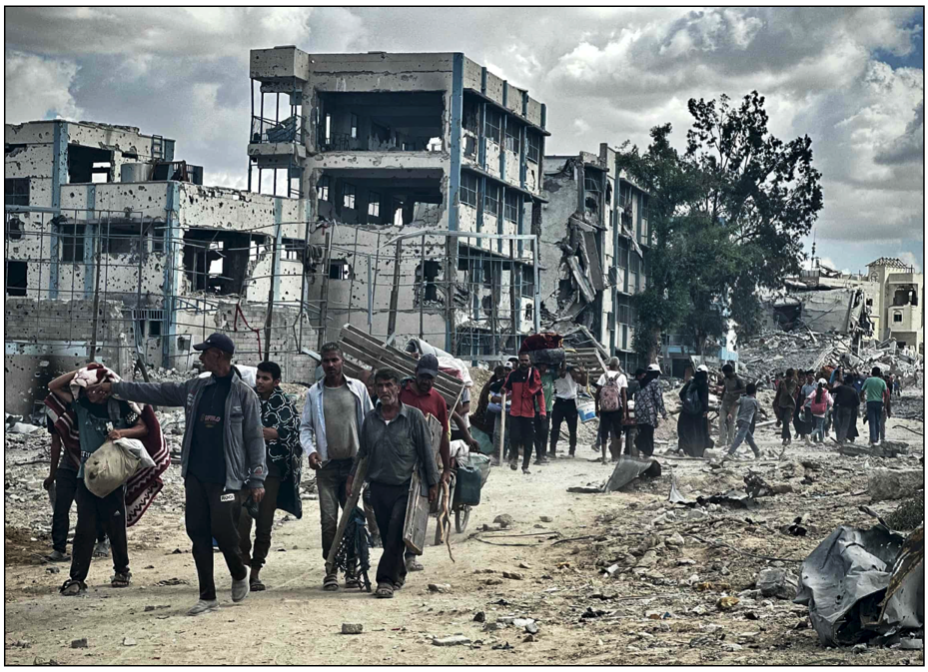
This photograph of Gaza portrays a street which looks like a valley of dry bones – a devastated terrain, in which we know, beneath the rubble, lie the lost but unforgotten dead. But it is also a picture of hope: for here are friends, families and neighbours walking together, carrying with them the possessions that they’ve recovered to help them begin to rebuild their lives. In that place, the Spirit is moving. Breath is re-entering these people’s bodies. Injured, yes, and troubled, yet they move forward together in hope.

To Martha and Mary, God healed the hurt in their hearts at the loss of their loved one, and secured a new beginning for them and Lazarus their kin. To anyone bereaved, whose heart is so hurting, just now, that they cannot see a future for themselves, what a hopeful message this is, that there is a life ahead for them to reach towards.

To Ezekiel, God offered an astonishing vision of the restoration of a whole society. To the faithless, broken, angry, hungry, homeless  peoples of our day, what a powerful message this is: that unity and community is still possible for them, and will come, through the loving actions of those who come together to make it happen.

From Martha and Mary to all the bereaved; from the Israelites in exile to all of today’s uprooted peoples, this is God’s promise, pregnant with hope:  ‘O my people. I will put my Spirit within you, and you shall live … then you shall know that I, the Lord, have spoken and will act, says the Lord.’

We close with a chant from the Taizé Community which echoes back to us the words Jesus spoke to Martha, “Did I not tell you that if you believed, you would see the glory of God?”

I am sure I shall see the goodness of the Lord 

in the land of the living.

Yes, I shall see the goodness of our God, 

hold firm, trust in the  Lord. [3] 

Notes 

[1] Drawing from my earlier sermons Can these bones live? God’s pregnant promise preached in Austwick, Clapham, Keasden, 2023, Can these bones live? Devon, 2011, and Ezekiel: voice of the exile, Croxteth, 2008

[2] Charles R. Biggs, Book of Ezekiel; Epworth Commentary, xii.

[3] Taizé Community, ‘I am sure I shall see the goodness of the Lord’. From the collection Christe Lux Mundi ℗ Ateliers et Presses de Taizé, 2020.

[4] Gaza, 2025. Photograph: Anadolu/Getty Images